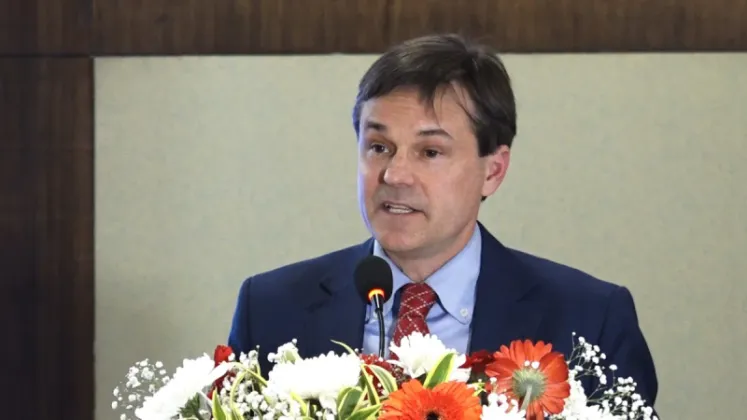
The United States Embassy in Nepal has urged the Government of Nepal to pursue business-friendly reforms, saying that a predictable tax system, protection of intellectual property rights and transparency in public procurement are essential if American investment and trade with Nepal are to grow. Deputy Chief of Mission at the US Embassy Scott Urbom made the remarks at an event organized by the Nepal-America Chamber of Commerce and Industry (NUSACCI) in Kathmandu, as reported by Nepali media on 28 November 2026. According to the embassy, building a business-friendly environment is central to strengthening the economic partnership between Nepal and the United States.
Three reforms the embassy wants to see
Speaking at the Kathmandu gathering, Urbom laid out the conditions that the United States believes would allow American companies to invest in and trade with Nepal on a larger scale. His message to the business community centred on three broad areas of reform.
-
Predictability of the tax system: The embassy stressed that investors need a tax regime they can understand in advance and rely on over the long term. In the embassy's framing, predictable taxation reduces uncertainty for companies weighing long-term commitments in Nepal and makes it easier to plan investment decisions.
-
Protection of intellectual property rights: Strong safeguards for intellectual property were highlighted as another prerequisite for expanded American investment. Protection in this area reassures firms that their technology, brands and other intangible assets will be respected, a matter the embassy tied to the confidence needed to bring investment into the country.
-
Transparency in public procurement: The embassy also pointed to open and transparent public procurement, an area that shapes how foreign bidders experience government contracts. Transparent processes, the argument runs, allow companies to compete on clear and equal terms rather than navigating opaque procedures.
According to the embassy, these three elements together form the foundation of the business-friendly environment it says is needed to expand US investment and trade in Nepal. The remarks were reported by RatoPati, Thaha Khabar and News of Nepal.
Strengthening the Nepal-US economic partnership
Beyond the specific policy asks, Urbom used the NUSACCI platform to stress the broader goal behind them: creating conditions in which the Nepal-US economic partnership can deepen. The event in Kathmandu, organized by the Nepal-America Chamber of Commerce and Industry, placed the embassy's message before the bilateral business community, a group with a direct stake in how Nepal regulates investment and trade.
The emphasis on a business-friendly environment reflects a consistent logic of foreign investment. Companies deciding whether to enter or expand in a foreign market weigh not only the size of the opportunity but also the reliability of the rules that govern it. Taxation that shifts without warning, weak intellectual property protection and opaque procurement each raise the perceived risk of doing business, which is why the embassy framed them as the key ingredients for expanding American investment.
By naming these areas publicly at a chamber of commerce event, the US Embassy signalled that it sees reform in Nepal's regulatory and institutional framework as the pathway to stronger two-way trade. The message was one of partnership conditioned on policy: economic ties with the United States, the embassy indicated, will grow as the environment for doing business in Nepal becomes more predictable, transparent and protective of investors' rights.
The road ahead
The embassy's remarks amount to a clear checklist for Nepal's policymakers. A tax system whose rules are stable and foreseeable, laws that defend intellectual property and procurement processes that stand up to scrutiny are, in the embassy's assessment, the reforms that would open the door to greater American investment and trade.
For NUSACCI and the wider Nepali business community, the statements delivered in Kathmandu also underline the role the private sector plays in this agenda. Bilateral chambers such as NUSACCI serve as a point of contact between American enterprise and Nepal's market, and the embassy's appearance at the event underscored the importance both sides place on that channel.
As reported on 28 November 2026, the message from Deputy Chief of Mission Scott Urbom was straightforward: the United States is ready to expand its investment and trade relationship with Nepal, but doing so requires a business-friendly environment built on predictability, transparency and the protection of intellectual property. How quickly Nepal's institutions are able to deliver on those fronts will shape the scale of American engagement with the Nepali economy in the years ahead.