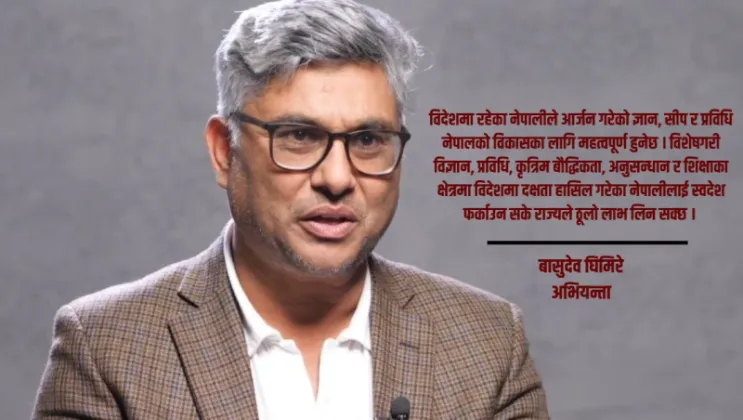
Basudev Ghimire, an activist of the 'Citizenship Where?' campaign, has called for the ancestral citizenship of Nepalis who have acquired citizenship of foreign countries to be continued, saying the issue should be treated as a national necessity for Nepal rather than as a personal need of those living abroad. Speaking in Kathmandu on Saturday, Ghimire argued that preserving the citizenship link of Nepalis who take up foreign nationality, and of the generations that follow them, would bring economic, social and technical benefits to the country. His remarks add a clear voice to the ongoing discussion over how Nepal should treat the citizenship of its people who have settled overseas.
A national necessity for Nepal
At the heart of Ghimire's argument is a deliberate reframing of the citizenship question. Demands connected with the status of Nepalis abroad are often presented as requests from the diaspora for personal convenience. Ghimire rejected that framing in his Saturday remarks, arguing instead that the continuity of ancestral citizenship is something Nepal itself needs. In his view, the question should not be measured only by what it means for individuals and families living overseas, but by what its continuation or loss would mean for the country as a whole.
The distinction he drew carries weight in a debate where the interests of the state and those of migrants are frequently placed on opposite sides. By describing the continuity of ancestral citizenship as a national necessity, Ghimire placed the burden of the argument on Nepal's own interest, positioning the diaspora's citizenship status as a matter of national concern rather than a private matter for families abroad.
The continuity at stake
Ancestral citizenship refers to citizenship held by descent, passed down through a family line rather than acquired through residence in another country. The issue becomes pointed when Nepalis acquire the citizenship of a foreign state: the question then arises whether their own connection to Nepali citizenship, and that of the children and grandchildren who come after them, continues or ends. Ghimire's position, as reported, is that this link must be continued.
His remarks also reached beyond the migrant generation. Coverage of his address framed the demand as one concerning descendants as well, indicating that the continuity he seeks is meant to apply to the generations of Nepali origin born and raised abroad. Questions of this kind sit at the intersection of descent-based citizenship and dual nationality, since a person who retains ancestral Nepali citizenship while holding another country's nationality carries, in effect, a formal tie to both.
Economic, social and technical gains
Ghimire said the continuity of ancestral citizenship would benefit Nepal across three broad areas:
- Economic benefits: a formal citizenship link with people of Nepali origin who hold foreign citizenship keeps open a channel of economic engagement between them and Nepal, which underpins his claim that the provision serves the nation.
- Social benefits: the link helps sustain family, community and cultural ties between Nepal and Nepalis abroad across generations, so that bonds rooted in ancestry are not severed when nationality changes.
- Technical benefits: continuity keeps Nepal connected to the knowledge, skills and expertise of people of Nepali origin living overseas, which he counted among the gains for the country.
The logic of his argument is straightforward: descendants of Nepali citizens who are born and raised abroad generally hold the citizenship of the country of their birth, and without a provision for continuity of ancestral citizenship the formal bond with Nepal ends with the migrant generation. Ghimire's contention is that Nepal, too, has a stake in that bond. Under his reasoning, a diaspora that remains formally tied to Nepal represents a resource for the country, not a population lost to it, and the economic, social and technical dividends he identified flow from preserving that tie rather than allowing it to lapse.
The 'Citizenship Where?' campaign
Ghimire made the remarks in his capacity as an activist of the 'Citizenship Where?' campaign. The name of the campaign points to the question at its centre: where does the citizenship of Nepalis stand once they, and the generations after them, live outside the country? By raising that question in public, the campaign works to keep the citizenship status of the diaspora and their descendants on Nepal's civic agenda, and Ghimire's address in Kathmandu formed part of that effort.
His intervention also reflects the growing visibility of voices arguing from the perspective of Nepalis abroad, a community whose formal relationship with the state has remained a contested subject in the country's public debate.
A demand addressed to the national debate
Citizenship has long been one of the most sensitive subjects in Nepal's public discourse, touching on identity, lineage and the rights of those who leave the country. Against that backdrop, Ghimire's call stands out for the way it speaks to the state rather than to the diaspora. By framing the continuity of ancestral citizenship as a national necessity, he asked Nepalis at home to regard the citizenship of those abroad as an asset belonging to the country, not as a favour extended to individuals who have moved away.
Whether that argument persuades the wider public and those who shape citizenship policy will become clear as the debate continues. For now, Ghimire's remarks, delivered in Kathmandu on Saturday, give the campaign a sharply stated case: that continuing the ancestral citizenship of Nepalis abroad is not charity toward the diaspora, but a step Nepal needs for its own economic, social and technical future.
Ghimire's remarks were reported by Pradesh Khabar, Nepal Views and Global Aawaj.