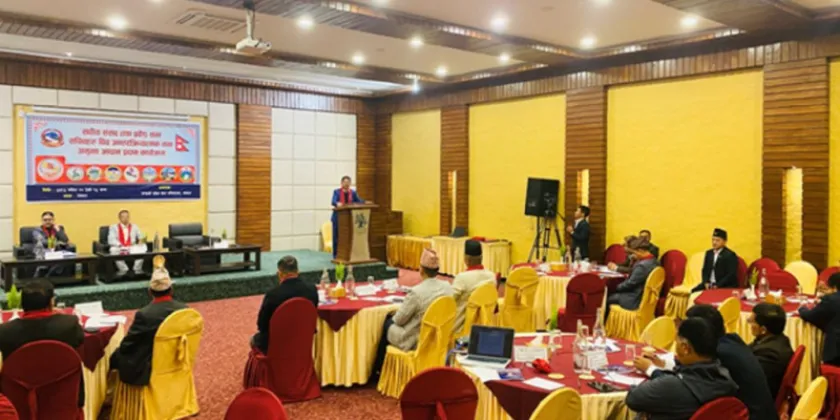
An interaction and experience-sharing programme for the secretaries of the Federal Parliament and the provincial assemblies began in Pokhara on Friday, with participants putting strong emphasis on making the role of the legislature more effective across all tiers of government in Nepal.
The programme brought together secretaries from the federal parliament and the provincial assemblies on a single platform to share experiences, discuss common challenges and explore ways to strengthen the institutional capacity of legislative bodies in the country.
Speaker Dital Calls for Review of Provincial Laws
Inaugurating the event, Gandaki Province Assembly Speaker Krishna Prasad Dital said that although the provincial assemblies have enacted a large number of laws since the provinces came into existence, the work cannot stop at law-making alone.
Speaker Dital stressed that the provincial assemblies must now review the laws they have passed, identifying which ones need proper implementation and which require amendment. According to him, simply enacting legislation is not enough; the real test lies in whether those laws are being effectively put into practice and whether they are serving the people they were meant to serve.
His remarks underlined a concern frequently raised in discussions about Nepal's post-federalisation legislative landscape: that provinces have been prolific in law-making, while the follow-up work of implementation, monitoring and revision has lagged behind.
Emphasis on a Strong and Effective Legislature
Participants at the Pokhara programme, which was covered by Nepalpress, Khabarhub and Ratopati, stressed that the role of the legislature should be made strong and effective.
The gathering served as a forum for the administrative heads of the legislative institutions to exchange notes on the functioning of parliament and the provincial assemblies. As secretaries are responsible for the overall management of legislative business, including the support systems that allow lawmakers to draft, debate and pass legislation, their role is central to how effectively the legislatures perform.
Context: Legislatures in Nepal's Federal Structure
Nepal's federal setup comprises the Federal Parliament in Kathmandu and seven provincial assemblies, each with its own secretariat and legislative calendar. Since the adoption of the new constitutional structure, the provinces have been busy building their legal foundations by enacting laws on a wide range of subjects within their jurisdiction.
However, questions have persisted about the quality of implementation of these laws and the need to revisit them as gaps emerge. The discussion led by Speaker Dital in Pokhara directly reflected this challenge, pointing to a phase in which provincial legislatures are expected to shift attention from the volume of legislation to its effectiveness.
Interaction and experience-sharing programmes of this kind provide an opportunity for the federal parliament secretariat and the provincial assembly secretariats to align their practices, learn from each other's experiences and build a common understanding of the support the legislatures need in the federal era.
Looking Ahead
The Pokhara event, which began on Friday, is expected to contribute to ongoing efforts to strengthen the legislative institutions of the country. With the emphasis placed by participants on a stronger and more effective legislature, and the call from the Gandaki Province Assembly Speaker for a careful review of provincial laws, the programme has highlighted the priorities that legislative administrations in Nepal are expected to focus on in the period ahead.
Further details of the discussions and outcomes of the programme are expected to be shared as the event progresses.