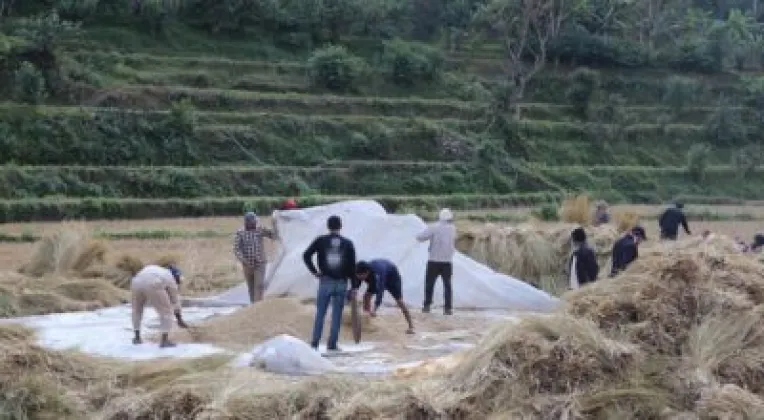
Rice production in Myagdi district has increased by 2.70 percent this year compared with the previous year, according to the Agriculture Development Office. The office credited the rise to favourable weather conditions, the absence of disease and pest problems, and the lack of hail damage during the farming season.
Office chief Sanjiv Bastola said that the combination of natural and seasonal factors worked in favour of farmers across the district, allowing paddy output to grow steadily over last year's figures. The office stated that adequate rainfall during the planting and growth periods, along with good weather at the time of harvest, helped ensure a better yield this year.
Weather played the decisive role
According to the Agriculture Development Office, the most significant contributor to the increased production was the weather. Rainfall remained sufficient during the planting season and throughout the growth phase of the paddy crop, which allowed fields across the district to receive the water needed for healthy crop development.
Equally important was the condition of the sky at harvest time. Good weather during the harvest period meant that farmers were able to cut, dry and store their paddy without interruption, reducing losses that often occur when crops are exposed to rain or excessive moisture at this stage.
Pests and diseases absent, hail spared crops
The office also highlighted that this year's crop remained free from disease and pest problems, which are among the most common causes of yield reduction in rice farming. Without infestations or outbreaks to contend with, farmers saw healthier plants and fuller grain heads across their fields.
In addition, Myagdi's paddy fields escaped hail damage this season. Hailstorms can devastate standing paddy crops shortly before or during harvest, and their absence removed one of the major risks that farmers in hilly districts typically face.
Context: rice farming in a hill district
Rice remains a principal cereal crop and a staple food in Nepal, and districts like Myagdi, located in Gandaki Province, depend heavily on agriculture for household food security and local livelihoods. Paddy farming in hilly terrain is particularly sensitive to weather patterns, as irrigation infrastructure is often limited and farmers rely on monsoon rains to water their fields.
Because of this dependence, small variations in rainfall timing and volume can make a large difference to annual output. A season with adequate rain at planting and growth, calm weather at harvest, and freedom from pests, disease and hail, as reported this year in Myagdi, is therefore closely watched by both farmers and agriculture officials as a measure of rural prosperity.
The Agriculture Development Office monitors crop conditions throughout the season and compiles production estimates based on the district's farming areas. Its assessment that production rose by 2.70 percent this year reflects the cumulative effect of the favourable conditions described by office chief Sanjiv Bastola.
While the increase is moderate rather than dramatic, steady year-on-year growth in paddy output is significant for a hill district, where cultivated land is often fragmented and terrain constrains expansion. The improved harvest is expected to support food supplies for farming households in the district, based on the figures and assessments released by the Agriculture Development Office.