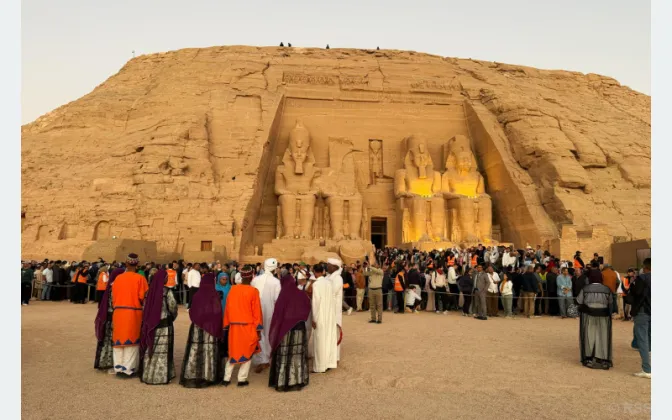
Hundreds of tourists and local residents gathered at the Great Temple of Ramesses II in Abu Simbel, southern Egypt, on Thursday morning to witness one of the ancient world's most striking astronomical events: golden sunlight entering the inner chamber of the 3,000-year-old temple and illuminating its statues. The phenomenon occurs only twice each year, on October 22 and February 22, and Thursday's gathering marked the latest occurrence of an alignment that continues to function exactly as it did when the temple was constructed roughly three millennia ago.
Sunlight Reaches the Heart of the Temple
As the morning sun rose over Abu Simbel, its rays traveled through the temple's interior until they reached the inner chamber, where they fell upon the statues housed there. The sight, which bathes the ancient sanctuary in golden light for a brief period, drew an audience of several hundred people, according to reports from RatoPati, Nagarik News and Rajdhani Daily.
The event stands apart from most attractions at archaeological sites because it cannot be experienced at will. The illumination depends entirely on the position of the sun, meaning the statues are lit from within on only two specific mornings each year. For the tourists and residents who assembled on Thursday, the alignment offered a rare, living connection to the astronomical knowledge of the temple's builders, who oriented the structure so precisely that sunlight still finds its way to the inner chamber 3,000 years after construction.
An Event Confined to Two Mornings a Year
What makes the Abu Simbel alignment remarkable is its strict regularity. The phenomenon does not depend on variable conditions or shifting calendars; it recurs on fixed dates, producing the same effect year after year. The key features of the event are:
- Golden sunlight enters the temple's inner chamber and illuminates its statues.
- The occurrence is limited to two mornings per year, on October 22 and February 22, with no other dates producing the same effect.
- The temple at the center of the spectacle was built by Ramesses II and is roughly 3,000 years old.
- Each occurrence draws large crowds, as demonstrated by the hundreds of spectators who gathered on Thursday.
Because the dates are fixed well in advance, the alignment functions as an appointment between the monument and the sky. Thursday's display has now passed for this cycle, but the phenomenon is set to return on February 22, when the sun will once again trace its path into the inner chamber. Visitors wishing to witness the event must time their trips to one of those two mornings, a constraint that has made every occurrence a major gathering point at the southern Egyptian site.
The Legacy of Ramesses II in Stone and Sunlight
The monument at the heart of the event was built by Ramesses II, one of the most prominent rulers of ancient Egypt, and it remains a 3,000-year-old testament to the architectural and astronomical sophistication of his civilization. That sunlight can still enter the temple's inner chamber on precise dates each year reflects the deliberate orientation built into the structure by its ancient designers, who aligned the building with the movement of the sun across the sky.
The fact that the alignment continues to work more than thirty centuries after construction adds considerably to the event's appeal. Modern spectators are effectively watching the same interplay of architecture and celestial mechanics that the temple's builders engineered in antiquity, a continuity that few heritage sites anywhere in the world can offer.
A Rare Experience That Draws Crowds Twice a Year
The turnout on Thursday, made up of both tourists and local residents, underscores the enduring fascination the phenomenon holds. Twice each year, the routine of the site is transformed: a monument that is impressive in ordinary daylight becomes, for a short time, the stage for a display in which the sun itself completes the design of the temple's creators.
For those who missed Thursday's alignment, the next opportunity will arrive on February 22, when the golden light will again reach the inner chamber and illuminate the statues carved there. As it has for roughly 3,000 years, the sun will rise over Abu Simbel, enter the temple built by Ramesses II, and briefly bring its most hidden space into full view for the crowds waiting outside.
With its fixed twice-yearly schedule, the event at Abu Simbel remains one of the clearest demonstrations of how the builders of ancient Egypt married monumental construction to the rhythms of the sky, and why visitors continue to gather, generation after generation, to watch the light do its work.