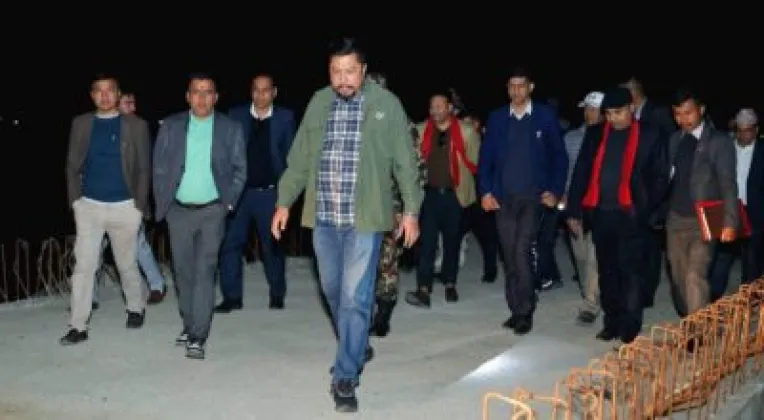
Minister for Energy, Water Resources and Irrigation Biraj Bhakta Shrestha on Friday inspected development and energy-related projects across Gandaki Province, beginning with a visit to the Rupa Lake Conservation and Integrated Development Project in Kaski district. Officials briefed the minister on the physical progress of the project, with the discussion focused on lake conservation, infrastructure development and improvements to electricity distribution. Beyond Kaski, the field visit also covers Syangja, Myagdi, Baglung and Parbat districts, where the minister is assessing damage caused by disasters and reviewing the problems affecting energy and irrigation infrastructure across the hill province, according to a report published by Khabarhub.
Rupa Lake inspection sets the tone
The stop at Rupa Lake combined two strands of the ministry's broad mandate: the protection of a major natural water body and the reliability of the power infrastructure that serves communities around it. The briefing the minister received on the project's physical progress covered three broad areas.
- Lake conservation, the core objective of the Rupa Lake Conservation and Integrated Development Project.
- Infrastructure development linked to the integrated development work underway at the lake.
- Electricity distribution improvements, reflecting the ministry's ongoing push to strengthen the supply network at the consumer level.
Rupa Lake, located in Kaski district, is one of the principal lakes of the Pokhara valley, a region where freshwater bodies have long drawn conservation attention. Integrated development projects of this kind are designed to pair ecological protection with local infrastructure, so that conservation gains are accompanied by visible benefits for the people living around the lake. By beginning the tour there, the ministry placed a flagship conservation initiative at the centre of a visit otherwise weighted toward disaster assessment and infrastructure review.
Five districts, one assessment mission
From Kaski, the itinerary extends across four more districts: Syangja, Myagdi, Baglung and Parbat. The stated purpose of this leg of the tour is twofold, namely to assess the damage that disasters have inflicted on energy and irrigation infrastructure, and to review the problems that continue to affect the day-to-day performance of those systems.
The five districts together span some of the most demanding terrain in the country. Gandaki Province stretches from the lake basin around Pokhara to the deep gorges of the Kali Gandaki and the high Himalayan reaches of Myagdi and Baglung. Its steep slopes, fragile soils and monsoon-swollen rivers make power lines, canals, embankments and access roads especially vulnerable, and landslides and floods in the hill districts routinely disrupt electricity distribution, undercut canal systems and damage river protection works, forcing repair campaigns after each rainy season. A first-hand inspection of this kind is intended to give the ministry a direct, ground-level picture of the damage and the operational bottlenecks rather than a picture filtered solely through district-level reporting.
Landslide control, embankments and irrigation on the agenda
Among the specific problem areas the tour is reviewing are landslide control, river embankments and irrigation. Each carries particular weight in a province with Gandaki's geography.
- Landslide control: slope failures are a recurring hazard across the hill districts, threatening settlements, farmland and the corridors through which power and water infrastructure pass.
- River embankments: rivers flowing through the province cut into their banks during the monsoon, and embankments serve as the main line of defence for villages and agricultural land along channels such as the Kali Gandaki and the Seti.
- Irrigation: farming in the hill districts depends heavily on canal networks, and damage to these systems directly undermines agricultural livelihoods, keeping irrigation a standing priority alongside the ministry's energy portfolio.
The pairing of energy and water concerns in a single field visit mirrors the integrated mandate of the Ministry of Energy, Water Resources and Irrigation, which oversees hydropower development, electricity distribution and the country's irrigation systems.
What is at stake for Gandaki
Gandaki Province occupies a significant place in Nepal's energy landscape. Its rivers, including the Kali Gandaki, the Seti and the Marshyangdi, rank among the country's best-known hydropower arteries and have long hosted major generation projects, while the province's distribution networks in the hill districts remain exposed to weather-related damage and maintenance backlogs. Irrigation coverage, meanwhile, is far from uniform across the farming areas, making periodic review of canal and river-training works essential.
The minister's Friday inspection, by pairing a flagship lake conservation project with a district-level assessment of disaster damage, highlights the twin challenges confronting the sector: building new energy and water infrastructure, and protecting and maintaining what already exists in some of Nepal's most disaster-prone terrain. Further details of the findings and any follow-up measures are expected once the five-district tour concludes.