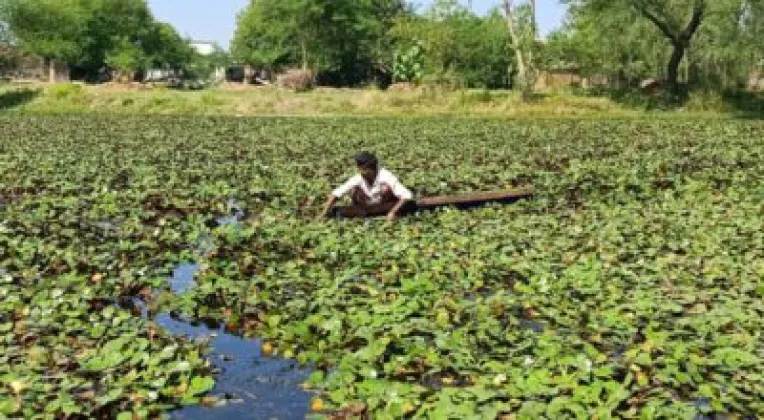
Prem Kashyap, a farmer from Neuwajigaun in Janaki Rural Municipality-2 of Banke district, has turned a traditional crop into a profitable commercial enterprise, earning about Rs 400,000 in a single season from water chestnut farming. Kashyap grows singada, as water chestnut is known locally, in a 15-kattha pond in his village and is currently in the thick of the harvest, spending long days gathering the crop from the water and selling it. His earnings, reported by Khabarhub and Nepal Press, underline the commercial potential of an aquatic crop long familiar to farming households across the Tarai plains.
From Traditional Practice to Commercial Farming
Water chestnut has been cultivated in ponds and waterlogged lowlands of the Tarai for generations, yet for many farming families it has remained a modest, seasonal side activity rather than a serious source of income. What distinguishes Kashyap's operation is the decision to treat the crop as a full commercial venture. By devoting a 15-kattha pond entirely to singada, he has built an enterprise capable of generating six-figure seasonal earnings from a single water body.
Neuwajigaun, the village where he farms, lies within Janaki Rural Municipality in Banke, a district in Lumbini Province where agriculture remains central to household livelihoods. Rather than regarding wet, pond-fed land as a constraint, Kashyap has used it as the foundation of his business. Water chestnut is a crop that thrives precisely in conditions where many other plants struggle, which means his pond serves a purpose that ordinary field land in the same village could not.
A Working Day That Begins at Dawn
The harvest season demands a punishing routine. According to the reports, Kashyap starts his day early in the morning, heading to the pond to collect the mature chestnuts from the water. The work does not stop there: harvesting and selling continue side by side throughout the day, with the farmer remaining engaged with his crop from the moment it leaves the pond until it changes hands with buyers.
That rhythm reflects the nature of a seasonal, perishable product. Water chestnuts must be gathered once they are ready and sold while they are fresh, and the concentrated window of the harvest leaves little room for delay. Kashyap's dawn-to-dusk schedule is, in effect, the engine of his seasonal income: the more consistently he can harvest and sell through the day, the more value he extracts from the crop during its short season.
The Economics of a Single Season
The headline figure is the roughly Rs 400,000 Kashyap has earned this season. For a crop grown in one pond over a single harvest period, that represents a substantial return in a rural economy where many households depend on small-scale cereal farming, daily wages or remittances. It also illustrates how land that is often dismissed as marginal, such as ponds and waterlogged plots, can be made to pay when matched with the right crop.
Kashyap's Season at a Glance
- Farmer: Prem Kashyap
- Village: Neuwajigaun, Janaki Rural Municipality-2
- District: Banke
- Crop: Water chestnut, known locally as singada
- Area under cultivation: A 15-kattha pond
- Income this season: Approximately Rs 400,000
- Routine: Harvesting from early morning, with sales continuing throughout the day
Water chestnut is a seasonal crop, which means both the labor and the income are concentrated into a particular window of the year. That concentration raises the stakes of the harvest period and helps explain the intensity of Kashyap's daily schedule while the season lasts.
A Crop Suited to the Tarai's Waters
Singada holds a familiar place in the food habits of the Tarai. The nut develops underwater in ponds and is gathered during the colder months of the year, and it is widely eaten as a seasonal snack, raw or boiled. Because it grows in standing water rather than in open fields, it gives farmers with ponds or poorly drained land a way to earn from terrain that is often unsuitable for staple crops such as rice, wheat or maize.
Kashyap's results give that logic a concrete price tag. A 15-kattha pond has produced around Rs 400,000 in one season on his farm, a figure that other pond owners in Banke and neighboring districts may find instructive. Where waterlogged land exists, farmers face a basic choice between leaving it underused or finding a crop suited to it; Kashyap's season shows that water chestnut can belong firmly to the second category.
A Model for Rural Diversification
Beyond the individual earnings, the case carries a broader message about agricultural diversification in Nepal's plains. Farmers who identify crops suited to their specific land and water conditions, and who work them on a commercial rather than casual basis, can unlock income that conventional use of the same land may never deliver. Kashyap's habit of staying close to the selling process, harvesting and selling throughout the day rather than handing the crop off early, is part of that equation as well.
For now, his attention remains on the harvest itself, with sales continuing daily from the village pond while the season runs. Whether other farmers in Janaki Rural Municipality and beyond follow his example will depend on factors ranging from access to suitable ponds to the labor that a water-grown crop demands. What is already clear, however, is that in the hands of a determined farmer, even a traditional crop like singada can sustain a genuinely commercial enterprise.