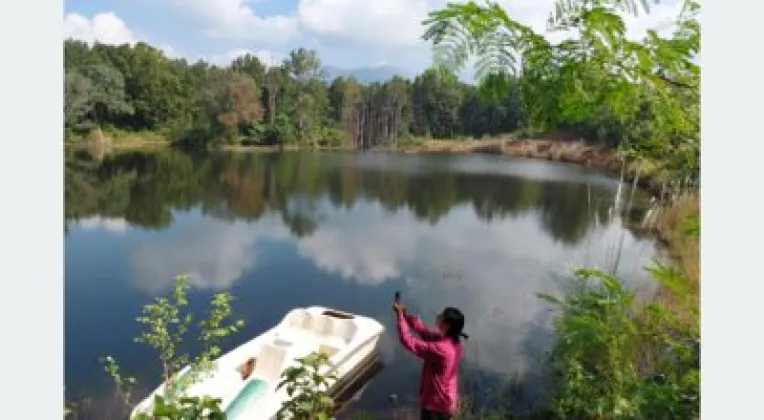
An artificial dam built in the Rani Community Forest area of Ward No. 18 of Tulsipur Sub-metropolitan City in Dang district has eased irrigation for local farmers, according to recent news reports. The structure has turned farmland that was previously dry and depended entirely on rainfall into productive agricultural land supported by a more dependable water supply. The development was reported by Khabarhub and Ratopati, both of which cited Govinda Nepali, chairperson of the local body, in their coverage of the project. For a farming area that has long been at the mercy of the monsoon, the dam marks a tangible shift in how, and when, crops can be grown.
A Reliable Water Source for Rain-Weary Farmers
Before the dam came up, cultivation in the area followed the rhythm of the rains. Without a dependable irrigation source, fields stayed dry for much of the year, and farmers could plant only when the monsoon arrived on time and in sufficient quantity. A delayed shower or an early end to the rainy season could put an entire cycle of planting at risk.
That picture has now changed. With water available more consistently, land that once produced little beyond the wet months is being farmed productively. The reports describe the outcome in straightforward terms: irrigation access has improved, and farmland that depended entirely on rainfall has become productive agricultural land with a more reliable water supply. For the farmers of Ward No. 18, that reliability is the difference between gambling on the weather each season and planning their cultivation with a degree of confidence.
How the Artificial Dam Fits the Landscape
Artificial dams of the kind built in the Rani Community Forest are typically small structures designed to collect and hold water, often from seasonal flows or monsoon runoff, and to make it available for farm use over a longer period. By capturing water close to its source and releasing it gradually, such structures extend the usefulness of a single wet season across more of the farming calendar.
The dam's location inside the community forest is also worth noting. Community forests in Nepal are managed by local user groups, and their role has steadily expanded beyond tree conservation to include water sources, foot trails and other assets that serve nearby settlements. Siting the structure within the Rani Community Forest points to the use of collectively managed land for the direct benefit of surrounding farm households, an approach that has become increasingly common as user groups look for practical ways to support local livelihoods.
Local Leadership and the Reports Behind the Story
Coverage of the project cited Govinda Nepali, chairperson of the local body, tying the initiative to local leadership's engagement with small-scale water infrastructure. While the reports did not detail the dam's dimensions, cost or the exact number of households served, both outlets agreed on the central outcome: irrigation has become easier, and rain-dependent fields have turned productive. That the two reports converge on these core points, with the local chairperson cited in the coverage, underlines the project's standing as a recognised local development rather than a passing claim.
The Broader Context: Rain-Fed Farming and Community Forests
The Dang project speaks to a wider challenge across Nepal. Much of the country's farmland is rain-fed, leaving agricultural output vulnerable to the timing and strength of the monsoon. Small-scale water harvesting, including ponds, tanks and low dams of this kind, is widely seen as a practical response, particularly in areas where larger canal networks are difficult to build or maintain.
Dang, an inner Tarai district of Lumbini Province, fits that profile, with farming communities whose fortunes rise and fall with the rains. Community forests, which are found across much of the Nepali countryside, offer ready platforms for such interventions because the land is already collectively managed and the user groups are organised. The Rani Community Forest dam is a modest but clear example of that model in action, showing how a single well-placed structure can change the economics of farming for a whole ward.
Key Points at a Glance
- The artificial dam is located in the Rani Community Forest area of Ward No. 18, Tulsipur Sub-metropolitan City, Dang.
- It has eased irrigation access for local farmers in the surrounding area.
- Farmland that was previously dry and fully dependent on rainfall is now productive, with a more reliable water supply.
- Govinda Nepali, chairperson of the local body, was cited in reports on the project.
- The development was reported by both Khabarhub and Ratopati.
For the farmers working the land near the Rani Community Forest, the true measure of the dam will be written in the seasons ahead, in the reliability of water at the field edge and in the crops it sustains. What the current reporting establishes is the starting point: a dry, rain-dependent patch of Dang has gained a steadier water supply, and with it, the possibility of farming on its own terms rather than the monsoon's. Further details are available in the original coverage from Khabarhub and Ratopati.