Farmers across Syangja district are increasingly turning to vermicompost as a substitute for chemical fertiliser, whose supply routinely falls short during the planting season. The organic manure, prepared from cattle dung and rotting vegetable waste, is now being produced not only for household use but also on a commercial basis, as growers seek a dependable way to keep their fields fertile without waiting for chemical fertiliser that often arrives late, in short quantities, or not at all.
The shift, reported by Nepali media outlets this week, has drawn growing interest among farmers in the district, where the shortage of chemical fertiliser during peak cultivation periods has long been a source of frustration. What began as an experimental alternative is steadily becoming a mainstream practice, with more growers preparing worm-based compost on their own farms and selling the surplus to fellow farmers.
A local answer to a recurring shortage
The shortage of chemical fertiliser during the planting season is a familiar problem for farmers in Syangja. When supplies run out at the very time fields need to be treated and sown, planting schedules slip and yields come under pressure. For many growers, the uncertainty has made reliance on chemical fertiliser an increasingly risky proposition.
Vermicompost offers those farmers an option that is available close to home. Because the raw materials, mainly cattle dung and decaying vegetables, are already generated on ordinary farmsteads, production does not depend on imports, transport networks or distribution schedules that can fail at critical moments. Farmers who prepare their own compost can apply it exactly when their crops need it, rather than waiting for supplies that may never arrive on time.
The growing interest in the practice reflects a practical calculation as much as an ecological one. With chemical fertiliser often scarce when it matters most, vermicompost gives farmers a measure of control over their input costs and planting calendars that they do not have when relying on externally supplied fertiliser.
How the compost is made
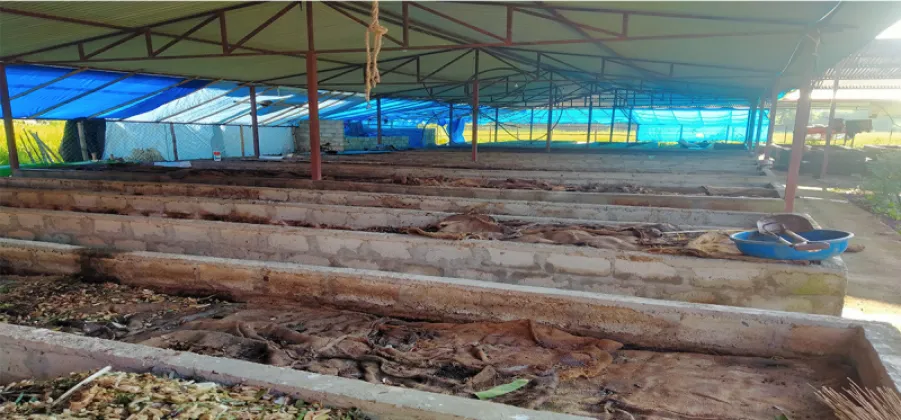
Vermicompost, also known as worm castings, is produced by letting earthworms break down organic waste. In Syangja, farmers use a mixture of cattle dung and rotting vegetables as feedstock. The worms process this waste into a dark, nutrient-rich material that can be spread on fields as fertiliser.
The method's appeal lies in its simplicity and low cost. The inputs are materials that farming households already have at hand, and the process converts waste that would otherwise be discarded into a productive farm input. Once a composting setup is established, it can continue producing manure cycle after cycle, using waste streams that renew themselves on the farm.
Farmers adopting the technique say the compost helps improve soil fertility, replenishing fields with organic matter in place of chemical inputs. Better soil health, in turn, supports more stable harvests over time, which is precisely what growers whose land has depended on repeated chemical applications are looking for.
From household practice to commercial production
What sets the Syangja experience apart is that vermicompost production there has moved beyond subsistence use. Farmers in the district are producing the compost commercially, creating a local supply of organic fertiliser that other growers can buy when chemical alternatives are unavailable.
This commercial turn has two significant effects. First, it means that even farmers who have not yet set up their own composting units can access organic manure locally, rather than facing the fertiliser shortage alone. Second, it gives producing farmers a potential source of income from what was previously waste material, adding an economic incentive to a practice that is already agronomically attractive.
The availability of commercially produced vermicompost also reduces the district's dependence on chemical fertiliser more broadly. Every unit of organic manure applied to a field is a unit of chemical fertiliser that does not need to be sourced from outside, easing the pressure that seasonal shortages place on the farming calendar.
Growing interest and the road ahead
The response from farmers in Syangja suggests that the practice is spreading. Reports from the district describe growing interest among growers in adopting vermicomposting, both to fertilise their own fields and to participate in the emerging local market for organic manure.
The experience offers a case study in how farmers respond when the supply of chemical inputs proves unreliable. Rather than remaining dependent on a system that fails them at the planting season, growers in Syangja have built an alternative from materials on their own farms, using earthworms, cattle dung and vegetable waste to produce fertiliser on their own terms.
For now, the shift remains concentrated in one district, but its underlying logic applies widely across Nepal's farming regions, where the scarcity of chemical fertiliser during critical cultivation periods is a shared problem. As word of the Syangja experience travels, the humble worm casting, once little regarded outside composting circles, is finding a growing audience among farmers looking for a fertiliser they can count on.
Whether vermicomposting expands beyond Syangja will depend on many factors, but the district's farmers have already demonstrated the essentials: the technique works, the materials are locally available, and there is demand for the finished product. In a season when chemical fertiliser is once again in short supply, that combination has proved persuasive.