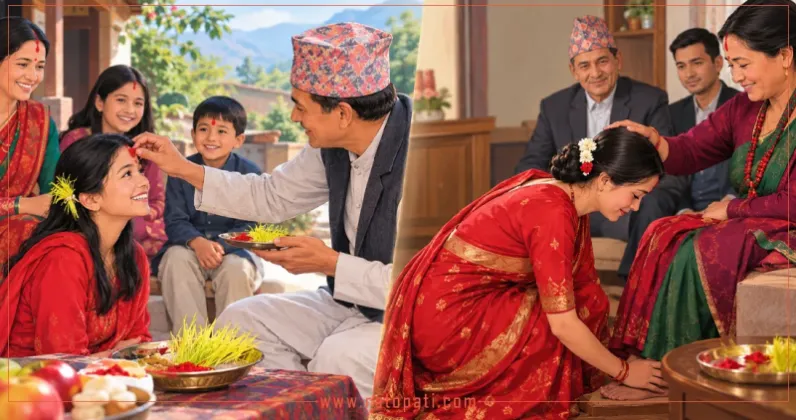
During Dashain in Nepal, elders give tika and jamara to younger family members on Vijaya Dashami, the festival’s main day of blessings and family gatherings. Red tika with yellow jamara is the most widespread custom, but it is not universal: some communities and families use white tika instead. Accounts of the tradition highlight both its familiar appearance and the variety of practices observed across the country.
A widespread custom, not a single rule
For many Nepali families, receiving red tika and yellow jamara from elders is a defining part of Vijaya Dashami. The custom brings together two colours that are closely associated with the festival: red on the forehead and yellow jamara given alongside it. The act is also described as an exchange of blessings between generations, making the moment more than a visual marker of the holiday.
But the familiar red tika should not be mistaken for a rule followed by every household. A Nepali-language explainer on Dashain’s tika traditions notes that practices differ among communities and families. Some use red tika, while others wear white. The variation means that a single image of Dashain cannot capture every family’s observance.
The distinction matters because festival customs are often described through their most common form. Red tika and yellow jamara may be the best-known combination, but its popularity does not erase other practices. The reported use of white tika is part of the same broader festival landscape, rather than evidence that every Nepali family follows an identical ritual.
Blessings and family reunions
Dashain is also a time when people return home and relatives who live far apart come together. An opinion piece reflecting on the festival describes the pull of home and the way Dashain brings distant relatives together. In that account, the season is associated with red tika, yellow jamara and blessings, as well as the gathering of family members.
That family dimension helps explain why the tika tradition carries significance beyond the colours themselves. For those who meet elders and relatives during Dashain, receiving tika and blessings can form part of a shared occasion that brings people together. The sources describe the festival as both a time for this familiar exchange and an opportunity for family members separated by distance to reunite.
The accounts do not identify one universal explanation for why some families use white tika while others use red. What they do establish is that the practices differ, and that the widely recognised red tika and yellow jamara are not the only way Dashain is observed. The variation is best understood as part of the diversity of customs across Nepal, rather than as a reason to assume that one colour represents every family or community.
What the traditions show
Taken together, the descriptions present Dashain through two connected themes: blessings passed between elders and younger relatives, and the return of family members to a shared home. Red tika and yellow jamara remain the most widespread expression of the Vijaya Dashami custom, while white tika is also worn in some communities and families. Both accounts centre on the festival’s role in bringing relatives together and marking the occasion with blessings.
For readers unfamiliar with the practice, the key point is that Dashain has a recognisable tradition without a single uniform form. The colours may differ from one family or community to another, even as the gathering and blessing associated with Vijaya Dashami remain central in the descriptions. Red and white tika therefore reflect variation within the observance, while the festival’s wider emphasis on family reunion and blessings connects the different customs.