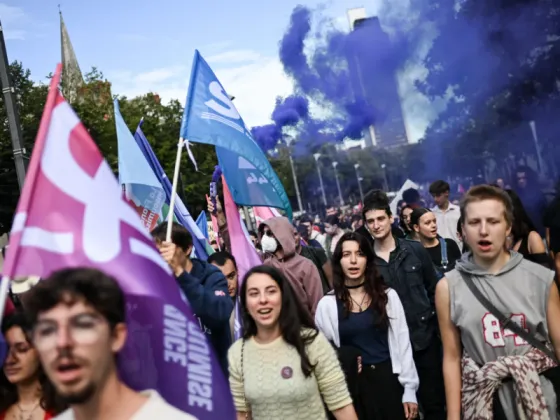
Large-scale protests led by young people have erupted across nine European countries, with demonstrations reported in France, Italy, Belgium, Spain, Portugal, Albania, Germany, Austria and Greece, according to a report published by NepalPress on 22 October 2026. Demonstrations in various cities have turned violent in some places, and protesters in Albania have targeted government offices, underlining how directly the anger is aimed at the machinery of the state. The unrest has drawn comparisons to the Arab Spring, the wave of uprisings that toppled authoritarian regimes across the Middle East around the end of 2010. Beneath the geographic spread lies a single thread: deepening dissatisfaction among the younger generation with the political and institutional arrangements they have inherited.
From Western Europe to the Balkans
The geographic sweep of the mobilisation is one of its most striking features. Young people have taken to the streets in:
- France and Belgium in Western Europe,
- Germany and Austria in Central Europe,
- Italy, Spain, Portugal and Greece in Southern Europe,
- Albania in Southeastern Europe.
A movement spanning nine countries with different governments, political systems and protest cultures is unusual, and it suggests that the grievance driving people onto the streets is not confined to any single national context.
According to the report, demonstrations have taken place in various cities across the nine countries, and they have turned violent in some places. The confrontation has been most pointed in Albania, where protesters targeted government offices. That choice of target signals that the anger is aimed squarely at the institutions of the state rather than at incidental symbols of authority. The report characterises the protests as large-scale and youth-driven, indicating that it is the younger generation, rather than established political forces, that is supplying the energy behind the wave.
Echoes of the Arab Spring
The most consequential framing attached to the protests is the comparison to the Arab Spring. That comparison invokes the wave of street uprisings that began around the end of 2010 and swept across the Middle East, ultimately toppling entrenched authoritarian regimes. By reaching for that precedent, commentary on the unrest places the current European protests in a lineage of youth-led, street-based movements that confront established power head-on.
The parallel is not exact. The Arab Spring unfolded under authoritarian regimes, where pressure from the streets could translate directly into the fall of governments. The nine countries now experiencing protests operate within democratic frameworks that contain formal mechanisms for changing power. Yet the comparison captures something real: in both cases it is young people who are occupying public space to voice their rejection of existing political and institutional arrangements.
The NepalPress report captures the dilemma in its own title, asking how to understand the anger of young people in Europe: is it an attempt to overthrow power from the streets, or a struggle to survive?
Overthrow or survival: what the anger is about
Answering that question requires looking at what the report identifies as the root of the unrest: deepening dissatisfaction among the younger generation with existing political and institutional arrangements. The word deepening matters. It points to frustration that has accumulated over time rather than a reaction to a single event, and it suggests that young people across the nine countries see the arrangements governing them as increasingly at odds with their expectations.
The second half of the question, survival, implies that for many of those on the streets the protests are not an abstract political project but a matter of how they will live. Read this way, the anger expressed in France, Italy, Belgium, Spain, Portugal, Albania, Germany, Austria and Greece is less about who occupies the offices of power than about whether the existing system leaves room for the young generation at all.
The fact that the same dissatisfaction is visible across nine countries strengthens the reading that this is a generational phenomenon rather than a purely national one. Different governments, different political contexts and different cities, yet the same demographic is out in force. That convergence is precisely what makes the Arab Spring comparison resonate, because the uprisings that began around the end of 2010 also moved across borders as a shared wave of anger rather than as isolated national episodes.
A question Europe has yet to answer
As of the report's publication on 22 October 2026, the protests were described as ongoing across the nine countries. The report does not detail any official response from the governments concerned, leaving open how national leaders and European institutions will absorb the pressure building in their streets.
What happens next depends on the very question the report poses. If the anger amounts to a movement to overthrow power from the streets, the Arab Spring precedent shows that sustained youth mobilisation can remove governments that once appeared immovable. If it is instead a struggle to survive, then the protests are a demand aimed at existing systems rather than against them, and the burden of response falls on those systems themselves.
Either way, the current wave has established one fact: across nine European countries, a generation's dissatisfaction has moved from private frustration into public space, loudly enough to invite comparison with one of the most consequential protest movements of the modern era.