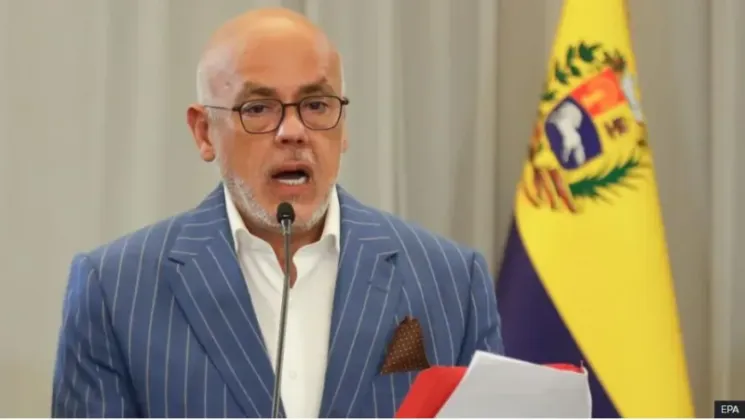
Venezuela will repeal a controversial law that bars opposition leaders from holding public office, National Assembly President Jorge Rodriguez announced on Thursday, in a move that could reshape the country's deeply contested political landscape.
The announcement, made in Caracas, concerns a law passed in 2024 that targeted individuals who promoted or supported sanctions against Venezuela. The legislation has long been viewed by the opposition as a tool of political persecution, used to disqualify prominent opposition figures from standing for or occupying public positions. Rodriguez's declaration marks the first formal signal from the government that the measure will be withdrawn.
What the Law Did
Enacted in 2024, the law provided a legal basis for barring Venezuelan citizens from holding public office if they were found to have promoted or backed international sanctions against the country. In practice, the measure was aimed squarely at the opposition, many of whose leaders had publicly called for or supported foreign sanctions as a means of pressuring the government.
For the opposition, the law became one of the clearest instruments of what it describes as systematic political persecution. By tying eligibility for public office to views on sanctions, the measure effectively allowed the state to disqualify its political rivals without resorting to overt bans, instead framing exclusions as legal consequences of disloyalty to the country.
Such disqualification mechanisms have been a recurring feature of Venezuelan politics, and the 2024 law formalized and expanded that practice. Opposition figures argued that it entrenched a system in which the ruling movement could decide who may compete for office, undermining any pretense of free and fair electoral competition.
The Announcement in Caracas
The decision to repeal the law was announced by Jorge Rodriguez, the president of the National Assembly, Venezuela's legislative body. As the country's top legislator, Rodriguez's announcement carries institutional weight and suggests the repeal will proceed through the formal legislative process.
No detailed timeline for the repeal was included in the announcement, which was reported from Caracas on Thursday. The move comes at a moment of heightened attention to Venezuela's political situation, and it will likely be scrutinized both domestically and internationally for how it is implemented in practice.
Why the Law Mattered to the Opposition
The opposition's core objection to the law has been that it facilitated political persecution rather than serving any legitimate legal purpose. By penalizing support for sanctions, the law targeted the opposition's most common political stance, since many Venezuelan opposition leaders have spent years appealing to foreign governments to pressure the ruling authorities over questions of governance and democracy.
Under the law's terms, advocacy for sanctions was treated as grounds for exclusion from public life, meaning that a leader's political platform itself could become the basis for disqualification. The opposition has maintained that this converted political disagreement into a punishable status, stripping candidates and officeholders of their rights without due process.
The repeal, if carried out, would remove one of the principal legal mechanisms used to keep opposition figures off ballots and out of office. Whether the government follows through fully, and whether other disqualification tools remain in place, will determine how meaningful the change proves to be for Venezuela's opposition movement.
Context: Sanctions and Political Exclusion
Sanctions have been a central fault line in Venezuelan politics for years. Opposition leaders have frequently supported or called for international sanctions as leverage against the government, while the ruling authorities have cast such advocacy as economic sabotage and betrayal of the country. The 2024 law translated that dispute into a formal legal standard, making support for sanctions a disqualifying offense for public office.
That approach effectively institutionalized political exclusion, giving the state a legal instrument to purge rivals from the political arena. The opposition's consistent position has been that such measures are not about protecting the country but about protecting the ruling movement from electoral competition.
Thursday's announcement, therefore, is significant less for what the law itself contained and more for what its repeal could signal: a potential softening of the machinery of political exclusion that has kept many opposition figures sidelined.
What Comes Next
The announcement from Rodriguez marks a turning point in rhetoric, but the test will lie in execution. The National Assembly, which Rodriguez leads, is the body that would carry out the repeal, and observers will be watching for the formal legislative steps to follow.
For the opposition, the hope is that repeal will open the door for disqualified leaders to return to public life and participate fully in the country's political process. For the government, the decision represents an acknowledgment, at least implicitly, that the law had become a source of contention and international criticism.
Until the repeal is formally enacted and its practical effects become clear, the announcement remains a promise rather than a change in law. Still, Thursday's declaration from Caracas stands as the most concrete step yet toward dismantling a measure that the opposition says was built for persecution, and its outcome will be a key indicator of where Venezuela's contested politics head next.