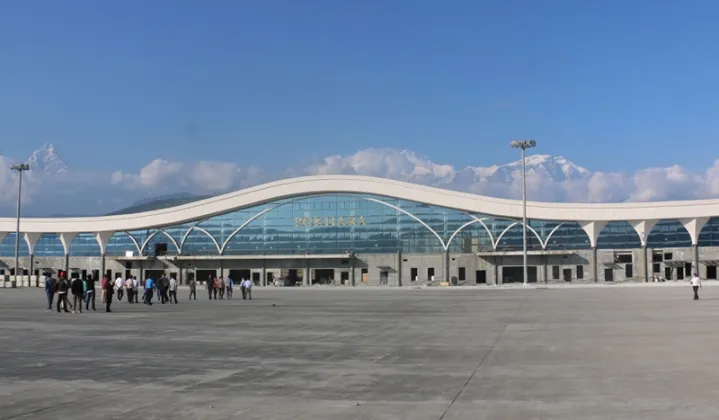
Nepal and India have reached a historic agreement on air routes, resolving a longstanding issue that had held back the full use of two of Nepal's most ambitious aviation projects. The deal opens the way for the operation of the Gautam Buddha International Airport at Bhairahawa and the Pokhara International Airport, both of which had been awaiting clarity on air entry points and routes to begin operating to their full potential. The agreement is being seen as a significant development in Nepal-India relations and carries expected economic and infrastructural benefits for Nepal.
What the agreement covers
The understanding reached between Kathmandu and New Delhi directly addresses the air route arrangements that Nepal had long sought from its southern neighbour. For Nepal, the practical impact is that the Bhairahawa and Pokhara international airports can now move toward regular operation, ending a period of uncertainty over how flights to and from these airports would be routed.
Both airports represent major national investments. The Pokhara International Airport was built with the ambition of boosting tourism in one of Nepal's most popular destinations, while the Gautam Buddha International Airport at Bhairahawa was developed to serve the densely populated Tarai region and to provide an alternative gateway to Lumbini, the birthplace of Gautam Buddha. The lack of agreed air routes had been repeatedly cited as an obstacle to the operation of these airports, making the new agreement a key step in unlocking their intended role.
Economic and infrastructural significance
The agreement is expected to bring tangible economic benefits to Nepal. With the two airports able to operate as intended, the country stands to gain improved air connectivity that can support tourism, trade and regional mobility. Better connectivity through Bhairahawa and Pokhara is expected to help both airports attract traffic and generate revenue, strengthening Nepal's wider aviation infrastructure.
Observers of the bilateral relationship have described the deal as a significant development in Nepal-India relations. The two countries have historically maintained close ties across trade, transit and people-to-movement, and the resolution of the air routes issue adds a new chapter to that cooperation. For Nepal, the ability to operationalise large infrastructure projects that had been constrained by external dependencies is being viewed as an important gain.
The infrastructural benefits extend beyond the two airports themselves. Operational international gateways at Bhairahawa and Pokhara are expected to distribute air traffic more evenly across the country, easing pressure on Tribhuvan International Airport in Kathmandu and supporting regional development in western Nepal.
A milestone in bilateral cooperation
The agreement is being welcomed as a historic milestone between the two neighbours. Air route arrangements have been a sensitive and complex subject in Nepal-India talks, and the fact that the two sides were able to reach an understanding is being read in Kathmandu as a positive signal for future bilateral negotiations.
For the travelling public and the tourism industry, the deal brings the prospect of smoother international connections through Pokhara, Nepal's tourism hub, and Bhairahawa, the gateway to Lumbini. As implementation moves forward, attention will turn to how quickly the two airports are able to begin full-scale operations under the new route arrangements.
The agreement stands as one of the more consequential recent outcomes in Nepal-India relations, with both countries framing it as a win-win arrangement. For Nepal, the immediate payoff is the opening of the way for Bhairahawa and Pokhara airports to operate, along with the economic and infrastructural benefits that are expected to follow.
- Nepal and India have reached a historic agreement on air routes
- The deal opens the way for the operation of Bhairahawa and Pokhara airports
- The agreement is expected to bring economic and infrastructural benefits to Nepal
- It is seen as a significant development in Nepal-India relations