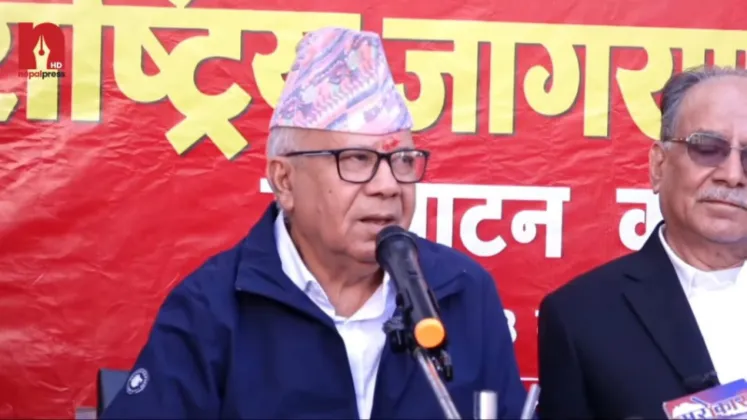
Madhav Kumar Nepal, co-coordinator of the Nepal Communist Party (NCP), launched a two-month National Awakening Campaign at the party office in Parisdanda, Kathmandu, on Saturday, saying it would reach out to citizens in defence of nationalism, national dignity, the constitution and the democratic republic. Speaking at the opening programme, Nepal said the party would not remain a silent spectator if anyone harmed national interests. He also responded to criticism of older political parties, arguing that claims about their record should be supported by facts.
A campaign focused on national interests
Nepal described the campaign as an effort to connect with people while prioritising nationalism and the protection of the constitution. The programme is set to run for two months. In his remarks at the launch, he presented these themes as central to the party’s purpose for reaching out to citizens, linking public engagement with the protection of national dignity and the democratic republic.
The campaign’s stated priorities bring together national identity and constitutional concerns. Nepal said the party intended to engage citizens around those issues rather than remain removed from public discussion. His message, as reported by Nagarik News, emphasised nationalism and safeguarding the constitution as priorities for the awareness campaign.
Warning against harm to national interests
Nepal also issued a warning about the party’s response if national interests were harmed. He said the NCP would not sit idly by or act as a silent spectator in such a situation. The statement set out a firm position on the issue, while his remarks about reaching citizens presented the campaign as a way to connect with the public on matters the party considers important.
The warning was framed around the protection of nationalism and national interests. Nepal’s remarks did not, in the information available, identify a particular person, organisation or event as posing a threat. Instead, he stated the party’s position in general terms: it would not remain passive if anyone acted against national interests. Ratopati’s report likewise highlighted Nepal’s warning that the party would not remain idle if nationalism were harmed.
Response to criticism of older parties
At the launch, Nepal also addressed claims that older political parties had done nothing. He said such claims must be checked against facts, rather than accepted without evidence. His response did not mean that criticism should be avoided; rather, he called for assertions about the parties’ record to be substantiated. Nepal Press reported his response to the claim that older parties had achieved nothing.
That part of Nepal’s remarks placed the campaign’s launch alongside a debate about how the record of established political parties is assessed. He focused on the need for factual support when making claims about what those parties did or did not accomplish. The information provided does not detail specific achievements or criticisms raised in that debate, but it records Nepal’s insistence that public claims should be judged on evidence.
The campaign, launched from the NCP office in Parisdanda, is therefore centred on two themes expressed at the opening programme: engaging citizens on nationalism and constitutional protection, and responding to political claims with an emphasis on facts. Nepal’s warning that the party would not be a silent spectator if national interests were harmed reinforced the position he set out as the two-month initiative began.