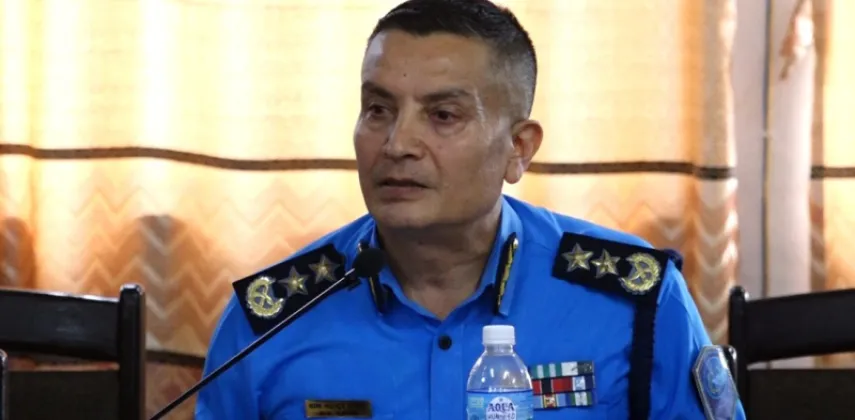
The Supreme Court is set to announce today whether it will register a writ petition filed by Dan Bahadur Karki, who was removed from the post of Inspector General of Police (IGP) and transferred as the security adviser to the Prime Minister. Karki has moved the apex court in Kathmandu seeking reinstatement to the country's top police post and the quashing of the government's decision through a certiorari order. The petition was kept for study at the Supreme Court on Thursday, and the decision on its registration is expected today, according to RatoPati.
The petition and what Karki is seeking
Karki's filing places the government decision to remove him from the IGP's office directly before the country's highest court. His central contention is that the move, which took him out of the police headquarters and reassigned him as the Prime Minister's security adviser, should be declared unlawful and set aside.
The petition makes two core demands:
- A certiorari order to quash the government's decision removing Karki from the post of Inspector General of Police and transferring him to the advisory role.
- Reinstatement as IGP, restoring him to the office he held before the transfer.
The filing has also been covered by Global Aawaj, which likewise reported that the petition was kept for study pending a decision on whether it would be accepted for registration.
Why the registration decision matters
In the Supreme Court's practice, a petition does not automatically proceed to a hearing the moment it reaches the court. Newly submitted writ petitions are first screened to determine whether they meet the requirements for registration, a preliminary stage in which the file is kept for study. It was at this stage that Karki's petition arrived on Thursday, and it is this stage that the court is now expected to bring to a conclusion.
The significance of today's decision is straightforward:
- If the petition is registered, the case will advance to the subsequent phases of litigation, where the government's decision can be examined in detail and contested by the parties.
- If registration is refused, the challenge will end at the threshold, without any ruling on the lawfulness of the removal, leaving the government's decision to stand.
Both RatoPati and Global Aawaj report that the decision on registration is to be taken today in Kathmandu.
Certiorari: the remedy at the center of the case
The legal instrument on which Karki relies is certiorari, one of the established writs through which superior courts review the legality of decisions taken by public authorities. Where a court finds that a decision was issued beyond the authority of the decision-making body or otherwise inconsistently with law, it can grant certiorari and nullify that decision.
The remedy carries a direct practical consequence in disputes of this kind. A successful certiorari petition does not merely criticize the decision under challenge; it removes that decision from the legal landscape, restoring the position that existed before it was made. That is precisely the outcome Karki's petition asks the Supreme Court to order: the annulment of the government's decision on his removal, and with it, the return of the IGP's office to him.
High stakes at the top of Nepal Police
The Inspector General of Police is the senior-most position in the Nepal Police, the institution at the front line of day-to-day law enforcement across the country. Decisions about who holds that office, and how an incumbent may be moved out of it, carry consequences beyond the individual concerned, touching the command structure and morale of the entire force. Given those stakes, executive decisions at this level are closely scrutinized and, when contested, land before the courts.
Karki's case follows that pattern. The executive exercised its authority to move him from the IGP's office to the role of security adviser to the Prime Minister, and he has now asked the judiciary to determine whether that exercise of authority was lawful. The court's answer, beginning with today's registration decision, will shape not only Karki's personal and professional future but also the question of who commands the national police force.
For now, the immediate question before the Supreme Court is a narrow one: whether the petition Karki filed should be registered at all. That determination, expected today in Kathmandu, will provide the first formal indication of how far his legal challenge to the government's decision is permitted to proceed, and whether the dispute over the top police post will receive the full hearing his petition seeks.