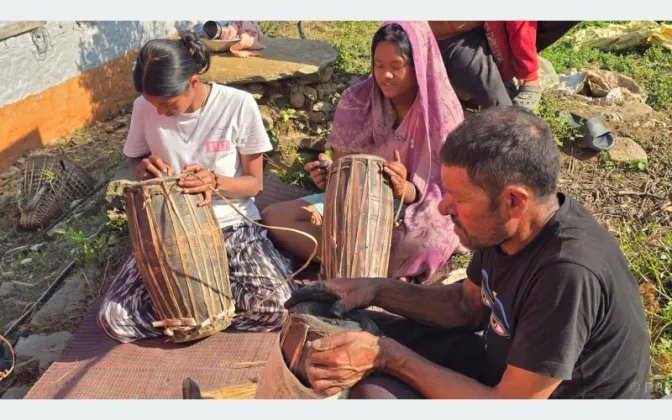
The traditional trade of handcrafting madals, the folk drum that anchors Nepali music and festivals, is in crisis in Okhaldhunga, a hill district in Koshi Province of eastern Nepal, where a steady decline in the number of skilled artisans has left the local market short of new instruments and made repairing old ones an uphill task. The occupation, which once hummed with activity during the Tihar festival, when demand for the drums traditionally peaks, has thinned along with its workforce. According to reports published by Rato Pati, Gorkhapatra Online and Nagarik News, buying a new madal in the district has become difficult, and so has getting a worn-out drum fixed.
A Trade That Once Set the Tihar Beat
The madal occupies a special place in Nepal's musical life. The barrel-shaped, two-headed hand drum, typically carved from wood and covered at both ends with leather, is widely regarded as the country's national instrument and provides the beat for folk songs, dances, weddings, village gatherings and, most prominently, the celebrations of Tihar.
For generations, the weeks before Tihar were the busiest stretch of the year for madal makers in Okhaldhunga. The five-day festival of lights is celebrated with deusi and bhailo singing from door to door, and a madal is almost always at the center of the procession. Families, youth clubs and cultural groups traditionally prepared for the festival by purchasing new drums or having old ones re-tuned, keeping local artisans occupied through the season.
That rhythm has now broken down. Reports from the district describe a market where new madals are hard to find, and where the routine job of repairing a drum that has served a household for years has become difficult to arrange. What was once a dependable seasonal trade has turned into a scarce service.
Fewer Hands Behind the Craft
At the heart of the shortage is the shrinking number of craftspeople who know how to make a madal. The work is exacting, demanding a combination of woodworking and leather-crafting skills:
- The wood must be selected, hollowed and shaped into the drum's barrel body.
- The leather heads must be fitted at both ends with precision.
- The skins must be tuned so the instrument produces its characteristic deep, warm sound.
Skills of this kind are acquired over years of practice, and in Okhaldhunga fewer and fewer people now possess them. As the artisan base has declined, the entire cycle of the trade has weakened. With fewer makers at work, the production of new drums has slowed, leaving the local market short of fresh instruments. Repair work, which requires the same knowledge and tools, has thinned out for the same reason, so owners of damaged madals increasingly have nowhere to turn.
The pattern mirrors pressures facing traditional occupations across Nepal, where laborious handicraft trades often struggle to hold on to practitioners even as demand for their products endures. In Okhaldhunga the gap has become plain: the appetite for the madal has not gone away, but the skills required to meet it have grown scarce.
Buyers and Musicians Feel the Squeeze
The consequences extend well beyond the artisans themselves. The shortage has produced a set of related problems for ordinary users of the instrument:
- New madals are hard to find in the local market.
- Buying a drum ahead of Tihar has grown difficult for families and cultural groups.
- Repairing old drums is now a challenge because few people remain who can do the work.
For a district where folk traditions remain strong, the shortage strikes at a familiar and cherished part of the culture. The madal is not a decorative relic but a working instrument, central to the songs and gatherings that mark the Nepali calendar. Its absence from the market is therefore felt not as an abstract loss of heritage but as a concrete inconvenience during the most festive weeks of the year.
An Uncertain Future for a Heritage Craft
The crisis in Okhaldhunga underscores how fragile traditional trades can become once the hands that sustain them begin to dwindle. A profession that once kept artisans busy through the Tihar season now struggles to serve even the demand that remains, and the continued decline in the number of craftspeople further erodes the district's capacity to make and mend the drums.
Any recovery will hinge on whether new practitioners can be drawn to learn the craft before the existing expertise fades altogether. For now, residents of Okhaldhunga face a simple but telling reality: the instrument at the heart of their festivals has become one of the hardest things to buy or repair in their own market, a quiet measure of how far the madal-making trade has slipped.