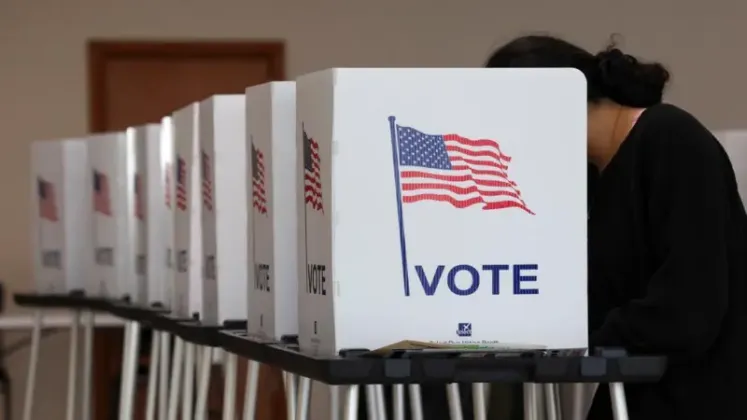
The Democratic Party is projected to win a majority in the United States House of Representatives, according to projections announced by the American television networks CBS and CNN. The calls were reported to Nepali readers by the outlets Nepal Lead and Baahrakhari on November 4, 2026, and were framed as a significant political and economic development in the United States. If confirmed by the certified count, the projections would hand Democrats control of the lower chamber of the US Congress, one of the most consequential outcomes of the country's 2026 midterm elections.
Networks Call the Chamber for the Democrats
CBS and CNN, two of the most prominent American broadcasters on election nights, each projected that Democratic candidates would secure enough seats to control the House of Representatives. Their calls were picked up and reported in Nepal the same day. According to Nepal Lead, the projections were carried on November 4, 2026, alongside the note that the outcome carries both political and economic significance.
Projection calls of this kind are a familiar ritual of American election coverage. Major networks maintain dedicated decision desks that weigh reported vote totals, precinct-level data and statistical models before declaring a winner or projecting control of a chamber. Such announcements are treated as authoritative by newsrooms but are not official results. Formal tallies are certified by election authorities in each state in the days and weeks that follow.
The Arithmetic and Power of a House Majority
The House of Representatives is made up of 435 voting members, each representing a congressional district, and a majority requires at least 218 seats. Representatives serve two-year terms, and every seat is contested in each national election, which is why each cycle can reshape, or flip, control of the chamber. That is the scale of what the CBS and CNN projections describe: enough Democratic wins across the country's districts to cross the 218-seat threshold.
What the Majority Controls
A working majority gives a party command of the chamber's machinery. In practical terms, that means:
- The Speakership: the majority party elects the Speaker of the House, the presiding officer of the chamber and second in the line of succession to the presidency.
- Committee control: the majority names the chairs of every committee, and those chairs decide which bills receive hearings, amendments and floor votes.
- The legislative agenda: the majority determines which measures come to the floor and which are kept from consideration.
- Oversight power: committee chairpersons direct investigations of the federal government and the executive branch.
The chamber's powers extend deep into fiscal policy in ways few other institutions match. Under the US Constitution, revenue bills originate in the House, giving the majority party a central role in taxation. The House also passes federal spending legislation and holds the sole power to initiate impeachment. Whoever controls the chamber therefore sits at the centre of American lawmaking for the two-year term ahead.
Political and Economic Stakes
The Nepali reports presented the projection as more than a political story, and the framing reflects the House's economic powers. The chamber writes and passes the federal budget, debates tax policy, and is a central actor in fiscal standoffs over government funding and the national debt. For businesses, markets and foreign governments, the party holding the gavel in the House is a key input into expectations about US fiscal policy over the next two years.
The reports available do not specify how many seats each party has won, the margins in individual districts, or the outcome of elections to the Senate and other offices. Those details typically fill in as counting continues and as broadcasters complete the remaining race calls. What the CBS and CNN projections establish, as reported in Nepal, is the headline result: Democrats will hold the majority in the House.
How the Call Reached Nepali Readers, and What Comes Next
The speed with which the projection reached Nepali audiences illustrates how closely American elections are followed internationally. Nepal Lead and Baahrakhari both carried the news on November 4, 2026, presenting it to their readers as a leading international development. Congressional decisions on spending, trade and immigration echo beyond American borders, and the composition of Congress is watched worldwide because it shapes policy with global reach.
The process now moves to certification and organization. The newly elected Congress is scheduled to convene in early January 2027, when incoming members are sworn in and the new majority organizes the chamber, elects a Speaker and assigns committee roles. Until then, the projected Democratic majority remains a projection by two major American networks, one that state-certified results will either confirm in detail or adjust at the margins as the final counts are completed.