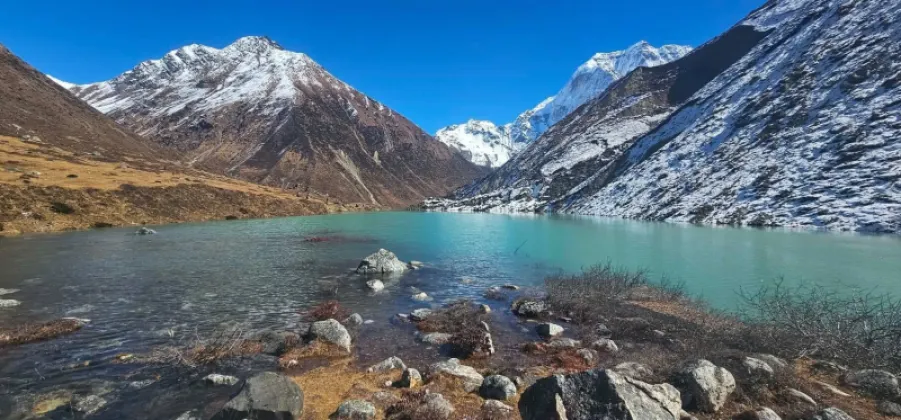
A dry landslide in the Samdo-Larke Bazaar area of Chumanubri Rural Municipality-1, Gorkha, has blocked the Remunang stream, a tributary of the Budhi Gandaki river, and formed a lake stretching roughly 150 metres behind the debris, according to reports published on Friday, November 6. The blockage occurred in the high-altitude terrain of northern Gorkha, where the stream descends toward its parent river. Chumanubri Rural Municipality chair Nima Lama said water is still flowing through the obstruction and that no major immediate risk is seen. Local residents, however, told Ratopati that the newly formed lake could burst, and people living along the banks of the Budhi Gandaki have been alerted as a precaution.
A stream dammed in the high Himalaya
According to a Ratopati report, the dry landslide struck the Samdo-Larke Bazaar area of Chumanubri Rural Municipality-1, one of the northern local units of Gorkha district. The debris has since acted as a natural barrier across the Remunang stream, impounding water and creating a lake estimated to be about 150 metres long.
The Remunang is a tributary of the Budhi Gandaki, one of the major rivers draining Nepal's central Himalayan region, which is why any obstruction in its channel is watched closely by communities downstream. Coverage by News of Nepal carried the same core details: a dry landslide, a blocked stream and an impounded lake of roughly 150 metres.
The key facts as reported:
- Location: Samdo-Larke Bazaar area, Chumanubri Rural Municipality-1, Gorkha
- Blocked waterway: Remunang stream, a tributary of the Budhi Gandaki river
- Size of impoundment: a lake about 150 metres long
- Official position: water still passing through the blockage; no major immediate risk
- Community concern: fears of an outburst; alerts issued along the Budhi Gandaki banks
Officials: water still flowing, no major immediate risk
The most significant detail in the official assessment is that the stream has not been completely sealed. Chair Nima Lama said water is still flowing through the blockage, a condition that keeps the impounded lake from swelling unchecked. In his view, the situation at present does not pose a major immediate risk.
The distinction matters because a landslide dam becomes most dangerous when it fully cuts off a channel, allowing water to accumulate rapidly behind the debris and raise pressure on the loose barrier. The continued flow observed at the Remunang blockage indicates the debris has not yet formed a watertight seal, which is central to the municipality's comparatively reassuring reading of the situation. As of the latest reports, Lama had not indicated any evacuation or displacement in the area surrounding the blockage.
Residents fear the lake could burst
Despite the chair's assessment, anxiety is running high among local residents. Speaking to Ratopati, people in the area said the lake formed behind the landslide debris could burst, a fear rooted in the behaviour of landslide-dammed water bodies, which can fail suddenly when the loose barrier gives way.
Acting on that concern, people along the banks of the Budhi Gandaki have been alerted. The river carries the outflow of the Remunang, meaning any sudden release of the impounded water would move downstream through the Budhi Gandaki system, where settlements sit along the banks. The alert, as reported, is aimed at keeping riverbank communities vigilant while conditions at the blockage site continue to be observed.
Why dry landslides and blocked streams are watched closely
The incident has drawn attention partly because of the type of slope failure involved. A dry landslide occurs without the trigger of heavy rainfall, which typically saturates and lubricates slope material. In high mountain areas such as the Samdo-Larke belt of northern Gorkha, such failures are associated with unstable rock and debris loosened in cold conditions, and they can occur even in dry, non-monsoon months, as the timing of this event suggests.
When landslide debris blocks a stream, the water pooled behind it forms a temporary lake whose stability depends on the composition of the barrier, the volume of incoming water and whether flow can still escape. A barrier that passes water, as the Remunang blockage currently does, is considered less immediately dangerous than a fully sealed one, but it can still fail if the debris shifts or inflow increases.
Downstream of the site, the Budhi Gandaki flows on through Gorkha, and communities along its course are the most exposed should the impounded lake release abruptly. That exposure explains why, even with the chair's reassurance of no major immediate risk, warnings have been relayed to people living along the banks.
Neither of the available reports mentions damage to property, injuries or displacement, and no estimate has been given for how long the blockage will remain in place. Attention in the coming days will focus on whether water continues to move through the debris, whether the lake grows further behind it, and whether the concerns voiced by local residents prove warranted.