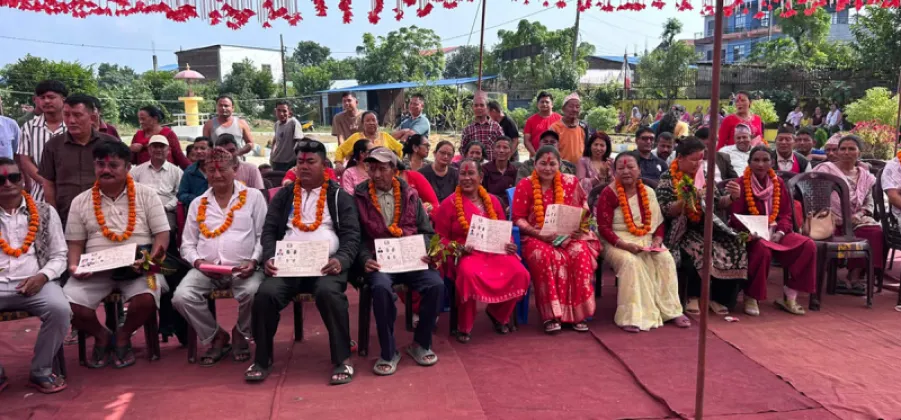
The District Land Problem Resolution Committee Chitwan handed land ownership certificates to 17 landless families in Ratnanagar Municipality-12 on November 6, 2026, formally recognising the families as legal landowners. The beneficiaries comprise one landless Dalit family, four landless squatter families and 12 families from unorganised settlements. The distribution marks a change in legal status for households described as having been deprived of land ownership for a long time.
Who received the certificates
The 17 recipient families fall into three groups identified by the committee: landless Dalits, landless squatters and families living in unorganised settlements. One certificate went to a landless Dalit family, while four went to landless squatter families. The remaining 12 were distributed among families from unorganised settlements. Together, the three groups account for all 17 households included in the handover.
The figures show that most of the recipients - 12 of the 17 families - belong to the unorganised settlement category. Four families were identified as landless squatters, and one as a landless Dalit family. The distribution therefore covers households with different classifications, while addressing a shared issue: the lack of formal land ownership recognised through a certificate.
The handover took place in Ratnanagar Municipality-12, in Chitwan district. The committee’s distribution was directed specifically to families in that ward; the information provided does not indicate that the certificates were issued to households elsewhere in the municipality. The total also refers to families, rather than individual recipients, so each of the 17 entries represents a household receiving formal recognition.
Legal recognition for long-deprived households
Land ownership certificates provide the recipient families with formal recognition as landowners. Before the handover, the families were described as landless or as living in unorganised settlements. The certificates change that status by documenting ownership, making the distribution more than a public presentation: it provides the households with formal proof of their land rights.
The committee’s action addresses a long-standing lack of ownership recognition for the local families. The summary of the distribution describes the beneficiaries as long-deprived, but does not specify how long each family had waited, the size or location of the plots, or the individual circumstances behind each claim. It also does not give details about the process used to verify eligibility. What is clear is that 17 families in Ward 12 received certificates, with the recipients drawn from the three stated categories.
The handover brings the number of families receiving certificates in this distribution to 17, including households identified as landless Dalit, squatter and unorganised settlement families. The Nagarik News report, Khabarhub report and Global Aawaj report provide coverage of the land certificate distribution in Chitwan.