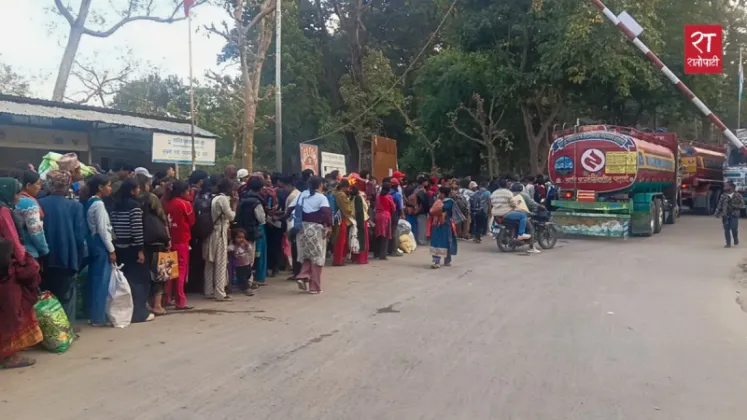
Workers from Sudurpashchim have begun returning to India for employment after celebrating Dashain, Tihar and Chhath at home, with around 6,000 Nepalis crossing into India daily through the Trinagar customs point in Kailali, according to the Armed Police Force’s border help desk there. Many had returned from Indian cities some time earlier to observe the festivals with their families and are now travelling back for work.
Daily movement through Trinagar
The figure reported by the help desk describes the current daily flow at the border point, rather than the total number of people who have returned to India. It indicates a substantial movement of workers through Trinagar as the festive period ends. The reported crossing is linked to employment: workers are heading to India to resume or seek work after spending time in Nepal.
The Trinagar customs point in Kailali is the location identified by the Armed Police Force’s border help desk as the point where the daily crossings are being recorded. The help desk’s estimate is the central measure available in the reports. It gives a clear indication of the scale of movement at that crossing, while not establishing how many people may be travelling through other border points.
Workers return after festival visits
The returning workers had travelled home from various Indian cities before the festivals. After celebrating Dashain, Tihar and Chhath, they have started making the journey back to India for employment. The movement therefore follows a period in which workers who had been living or working in Indian cities returned to Nepal for family and festival observances.
The reports do not specify how long each worker stayed in Nepal, which Indian cities they are returning to, or the types of jobs they expect to take up. They also do not provide a breakdown by district, age or occupation. What the available information establishes is the broader pattern: workers from Sudurpashchim are crossing into India again after the festive break, and the border help desk is seeing about 6,000 crossings a day at Trinagar.
Border help desk reports the flow
The daily estimate comes from the Armed Police Force’s border help desk at Trinagar. The figure offers a snapshot of movement at that customs point, but it should not be read as a count of all Nepali workers travelling to India nationwide. Nor does it indicate how many of those crossing are returning to jobs they previously held and how many are travelling in search of new employment.
The seasonal sequence is clear from the reported account: workers came back from Indian cities to celebrate the festivals, and the journeys towards India have resumed after those celebrations. The current crossings are thus part of the return movement described by the help desk, rather than a report of a single organised departure or a one-day total.
The return of workers after the holidays underscores the connection between festival travel and cross-border employment for people from Sudurpashchim. For now, the main reported indicator is the approximate daily figure at Trinagar. Further details about destinations, work sectors and the duration of the movement have not been provided in the available reports.