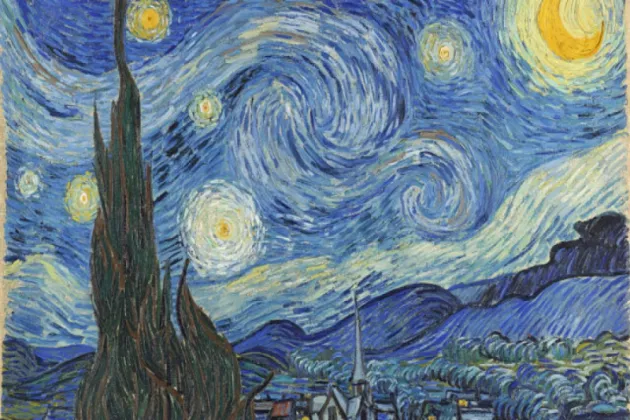
Vincent van Gogh's 'The Starry Night', one of the most recognisable paintings in the world, appears to be rooted not in pure imagination but in a real night sky, according to a new study that has traced the canvas's swirling heavens to a single evening: July 22, 1889. The research links the sky depicted in the celebrated 1889 masterpiece to the view from the French asylum where the Dutch painter was staying at the time, suggesting the work captures an actual astronomical moment from roughly 137 years ago. The findings, reported by My Republica and Ratopati, offer a striking answer to a question that has followed the painting for generations: was Van Gogh painting the sky as he saw it, or a sky as he dreamed it?
A sky long credited to imagination
Painted in 1889, while Van Gogh was staying at an asylum in France, 'The Starry Night' has long been celebrated as the ultimate expression of the artist's inner world. Its blazing stars, glowing crescent moon and rolling currents of light have often been read as the product of a mind that could reimagine the heavens rather than merely record them. The painting's energy seems to come from somewhere beyond ordinary observation, and that sense has shaped how generations of viewers have understood the work.
The new study challenges that long-standing assumption. According to the findings, the configuration of the sky in the painting corresponds to a real celestial scene, one that hung above the asylum on the night of July 22, 1889. In other words, the backdrop that has so often been described as boldly invented may have been drawn, at least in its essentials, from what Van Gogh could actually see.
Pinpointing the night behind the swirls
The precision of the dating is what sets the research apart. Rather than placing the painting loosely in the summer of 1889, the study ties its sky to one specific evening, giving the canvas something close to a timestamp. The key points of the findings can be summed up as follows:
- The sky depicted in 'The Starry Night' corresponds to the night of July 22, 1889.
- The scene is linked to the view from the French asylum where Van Gogh was staying.
- The research therefore dates the painting's celestial backdrop to a moment roughly 137 years ago.
- The findings suggest the work drew on direct observation of the night sky, not imagination alone.
That level of detail matters because the date carries its own quiet drama. July 22, 1889, fell within the months Van Gogh spent at the asylum, a period in which he continued to paint even as he lived apart from the world outside. The idea that this particular sky, on this particular night, may have found its way onto his canvas gives the painting an anchor in lived time that earlier readings never quite allowed.
Where observation meets imagination
The findings do not turn 'The Starry Night' into a simple record of what Van Gogh saw. Nothing in the study diminishes the expressive force of the canvas: the turbulence of its brushwork, the exaggeration of its light and the dreamlike rhythm of its composition remain entirely the artist's own. What the research suggests, instead, is that this invention was built on observation, that a real sky gave the painter the raw material he then transformed into one of art history's most enduring images.
That balance between seeing and reimagining has been at the heart of the painting's story since it was created. Scholars and enthusiasts have long debated how faithfully the canvas mirrors the heavens Van Gogh actually looked at, and the new study now comes down on the side of realism, at least where the stars are concerned. It also fits into a wider effort to treat great paintings as documents of the world that produced them, reading works of art against the skies, seasons and landscapes that surrounded their makers.
A masterpiece anchored to a moment
For the millions of people who have stood before 'The Starry Night' or come to know it through reproductions, the study adds a poignant layer to an already powerful image. The painting was made by an artist living within asylum walls, looking up at the night from a place of confinement, and the new findings suggest that what he saw up there, on one specific July evening, was extraordinary enough to survive on canvas for nearly a century and a half.
Nearly 140 years after that night, the research brings viewers a little closer to Van Gogh's vantage point. The swirling sky that has so often been described as pure imagination now appears to have had a real counterpart over the French asylum where the painter stayed, on July 22, 1889. The stars, it seems, were really there. What remains wholly Van Gogh's is the way he made them move.