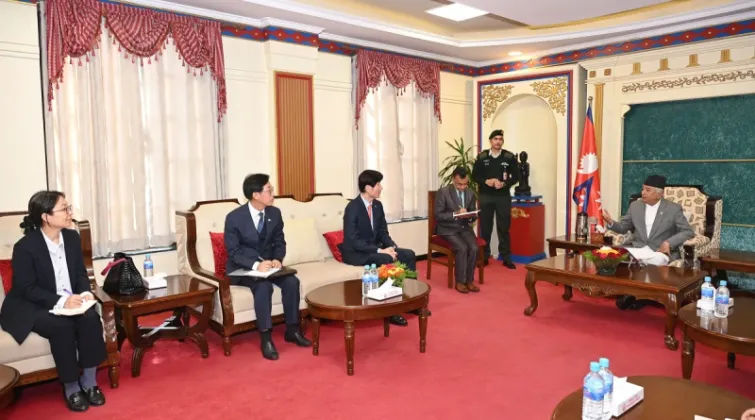
President Ram Chandra Paudel received Park Jae-kyung, the Ambassador of the Republic of Korea to Nepal, during a courtesy call held at the President's Office in Maharajgunj, Kathmandu, on Friday. According to the President's Office, the two sides discussed bilateral relations between Nepal and South Korea. The meeting took place against the backdrop of a partnership that has grown steadily since the two countries established diplomatic relations in 1974, encompassing labour migration, tourism, development cooperation and close people-to-people ties.
A Diplomatic Ritual at Sheetal Niwas
The Korean envoy's call on the President followed a well-established practice of international diplomacy, under which ambassadors posted to a country meet its head of state to convey the greetings of their government and exchange views on matters of mutual interest. Although such meetings are largely ceremonial in nature, they carry symbolic weight, signalling the importance that both capitals attach to the relationship and offering an early opportunity to take stock of ongoing cooperation.
In Friday's meeting, President Paudel and Ambassador Park discussed the state of relations between Nepal and the Republic of Korea, according to the President's Office. The Office did not make public the specific issues raised during the conversation, and no further details of the discussion were immediately available.
The meeting drew coverage from Nepali media houses, including Ratopati, Nagarik News and Gorkhapatra Online, all of which reported that bilateral relations featured in the discussion.
More Than Five Decades of Bilateral Ties
Nepal and the Republic of Korea established formal diplomatic relations in 1974, and in the five decades since, the relationship has expanded well beyond its early foundations to cover trade, investment, culture, education and, most visibly, labour migration. South Korea today stands among the most favoured destinations for Nepali job seekers, with tens of thousands of Nepali workers employed there under the Employment Permit System, a government-to-government labour arrangement between the two countries.
The earnings that these workers send home have made South Korea a meaningful source of remittance for Nepal, contributing to household incomes and to the national economy. The growing Nepali community in Korea has, in turn, forged human bonds between the two societies that go well beyond formal diplomacy.
While the President's Office did not disclose the specific agenda of Friday's conversation, the Nepal-Korea relationship rests on several well-established pillars:
- Labour and employment: South Korea remains a preferred destination for Nepali workers recruited through the Employment Permit System, with thousands travelling there for work each year.
- Tourism: Korean visitors are a steady presence on Nepal's trekking routes and cultural sites, with Lumbini, the birthplace of Gautam Buddha, holding particular appeal for travellers from Korea.
- Development cooperation: Korean assistance has supported projects in Nepal's health, education and infrastructure sectors over the years.
- Trade and investment: Bilateral commerce, though modest in volume, continues to offer scope for expansion as both sides explore new areas of economic partnership.
Tourism constitutes another visible thread in the friendship. Korean travellers are a familiar sight on Nepal's mountain trails and at heritage landmarks across the country, while Korean language classes, films, music and television dramas have gained popularity among young Nepalis in recent years, adding a contemporary cultural dimension to the bilateral relationship.
Why the Meeting Matters
For Nepal, contacts of this kind carry practical significance. Foreign employment and tourism rank among the country's principal sources of foreign currency, and South Korea is a key partner in both areas. Korean support for development projects has further made Seoul a valued partner alongside its role as a destination for Nepali workers, giving the relationship both economic and human depth.
Courtesy calls at the President's Office, though brief, also serve as a reminder of the continuity of Nepal's foreign relations. Successive governments in Kathmandu have placed consistent emphasis on maintaining warm ties with countries that host large numbers of Nepali workers and visitors, and South Korea figures prominently in that approach. Meetings between the President and serving ambassadors are a regular feature of diplomatic life at Sheetal Niwas, providing a forum for friendly exchanges that complement the day-to-day work of the two foreign ministries.
Friday's meeting between President Paudel and Ambassador Park, in which the two sides discussed the state of bilateral relations, thus fits within a broader pattern of steady engagement between Kathmandu and Seoul. As Nepal and the Republic of Korea look to deepen their cooperation in the years ahead, high-level contacts of this nature help sustain the goodwill and mutual understanding on which the five-decade-old relationship has been built.