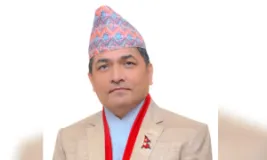
Dr Shashank Koirala, coordinator of the Nepali Congress 15th General Convention Preparation Committee, has said that party conventions and general conventions should be seen as opportunities for leadership change, competition and unifying the party and its organisation.
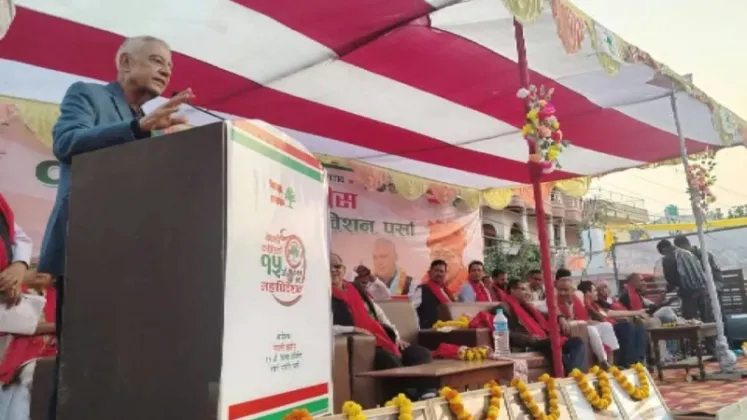
Speaking at the inauguration of the Parsa district convention, held under the Nepali Congress's 15th regular general convention, Koirala underlined that the purpose of holding conventions at every level of the party is not merely to fill posts but to strengthen and consolidate the organisation. He said that if the party can unite through the convention process, an environment will be created in which everyone supports one another.
Competition in conventions is natural
Koirala acknowledged the reality that internal competition is an inherent part of the convention process. He noted that while there is one post, many colleagues aspire to it, and said that competition in conventions is natural. His remarks appeared intended to frame contests for party positions not as sources of division, but as a normal and healthy feature of democratic party life.
By emphasising that ambition for leadership should be channelled through conventions, Koirala sought to reassure party members that differing aspirations need not weaken the Nepali Congress. Instead, he argued, the process of contesting and resolving those aspirations through formal party structures can ultimately serve the larger goal of unity.
Unity as the key to electoral strength
Delivering a message aimed at party workers gathered in Parsa, Koirala stressed the connection between internal unity and the party's overall strength. According to Nepal Press, his central theme was that unity is the party's greatest asset, and that the convention process should strengthen rather than fragment it.
Koirala, who holds a key organisational role as coordinator of the preparation committee for the party's 15th general convention, has been overseeing preparations as the party moves through its convention cycle. District-level conventions, such as the one inaugurated in Parsa, form part of the sequence of gatherings that lead up to the general convention itself.
The 15th general convention process
The Parsa district convention was inaugurated under the Nepali Congress's 15th regular general convention. District conventions are a stage in the party's broader organisational renewal, in which local and district leadership positions are contested and delegates are chosen for higher-level gatherings.
As coordinator of the 15th General Convention Preparation Committee, Koirala is centrally involved in managing this process across the country. His comments in Parsa reflect the message he is carrying to party members at the district level: that the conventions currently under way should be treated as moments for renewal, leadership change and organisational consolidation rather than as occasions for rivalry to harden into lasting splits.
A message of mutual support
In his address, Koirala painted a picture of what a successful convention process should produce. He said that if the party can unite through the convention, an environment will be created in which everyone supports one another. This vision of mutual support, he suggested, is what allows the party to emerge from its internal contests stronger and more cohesive than before.
His remarks come at a significant moment for the Nepali Congress, as the party works through the district conventions that form part of the run-up to its 15th regular general convention. With a single post and many aspirants, as Koirala himself observed, the conventions naturally generate competition. The challenge, as he framed it, is to ensure that this competition strengthens the party's organisation rather than weakening it, so that a unified Congress emerges from the process ready for the tasks ahead.
Koirala's message to Parsa party workers was clear: unity achieved through the convention process leaves the party well placed, and a united Nepali Congress is difficult to defeat.