Bollywood superstar Shah Rukh Khan has sent a defamation legal notice to Instagram content creator Suvigya Sharma, accusing her of presenting a conversation with industrialist Anant Ambani in a misleading and defamatory context. The dispute centres on a viral reel that captured a brief exchange between the actor and the Ambani scion in the presence of spiritual leader Sadhguru, which Sharma allegedly misrepresented to suggest an entirely different narrative.
According to reports, the notice gives the influencer a 48-hour ultimatum, and the controversy has since ignited a wider debate over the boundaries of freedom of expression and the limits of defamation claims in the age of viral social media content.
What the viral reel showed
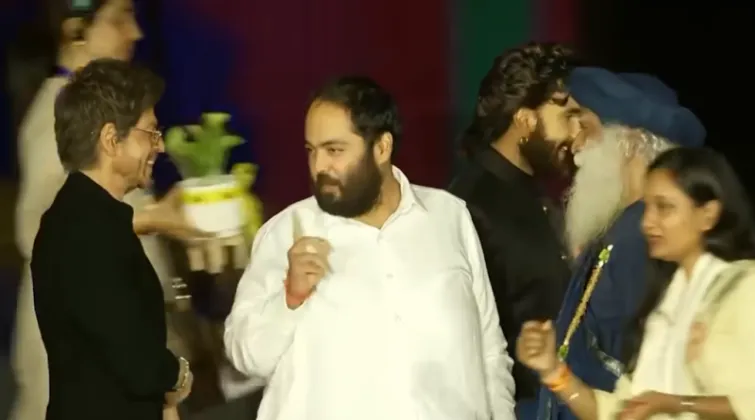
The controversy began when a short video clip featuring Shah Rukh Khan and Anant Ambani circulated widely on social media. In the footage, which was filmed in the presence of Sadhguru, Ambani could be heard telling the actor to "shut up" during what appears to be a light-hearted exchange between the two.
Suvigya Sharma, an Instagram content creator, shared or commented on the clip in a manner that Khan's legal team contends distorted the context of the interaction. According to the actor's notice, Sharma presented the conversation in a misleading way, portraying the exchange as something defamatory rather than the casual banter it was claimed to be.
The reel quickly went viral, drawing millions of views and triggering speculation about tensions between the actor and the Ambani family. It was this viral spread, and the reputational damage alleged in the notice, that prompted Khan to pursue legal action.
The legal notice and 48-hour ultimatum
The legal notice sent to Sharma accuses her of defaming the actor by misrepresenting the video. Reports indicate that she has been given 48 hours to respond, comply with the demands set out in the notice, or face further legal proceedings.
Defamation notices of this kind typically demand the removal of the offending content, a public apology or retraction, and an assurance that no similar content will be published in the future. The notice to Sharma is reported to contain a similar ultimatum, putting the influencer under immediate pressure as the deadline approaches.
Khan's decision to escalate the matter legally reflects a growing trend among Indian celebrities, who have increasingly turned to defamation law to counter content they perceive as damaging on social media platforms, where a single viral post can reach audiences far beyond traditional media.
A debate over free speech and defamation
The legal action has sparked debate across social media and news circles, with commentators weighing the actor's right to protect his reputation against questions about freedom of expression for online creators. Supporters of the notice argue that misrepresenting a video to imply something false about a public figure crosses the line from commentary into defamation. Critics, however, contend that legal threats against small influencers over short-form content raise concerns about the chilling of online speech and the power imbalance between global celebrities and individual creators.
The case also highlights the challenges posed by short-form video platforms such as Instagram Reels, where clips are often stripped of context, captioned with provocative framing, and amplified by algorithms into viral moments. What may have been an innocuous exchange at a private or semi-private gathering can, within hours, become fodder for millions of interpretations.
What happens next
Attention now turns to Sharma's response within the 48-hour window set out in the notice. Depending on her reaction, the dispute could either be resolved quietly, with the content removed and a clarification issued, or escalate into formal litigation in Indian courts, a process that could set a precedent for how defamation law is applied to viral social media content.
For Shah Rukh Khan, one of Bollywood's most prominent figures, the episode underscores the reputational stakes of viral media even for the biggest stars. For creators like Sharma, it serves as a reminder that content built on real public figures carries legal risk when context is altered.
The controversy, which originated with a few seconds of footage involving Anant Ambani and the actor in front of Sadhguru, has grown into a test case of sorts for the intersection of celebrity reputation, defamation law, and the rapidly evolving culture of short-form content in India.
As the deadline set in the legal notice passes, both the influencer community and entertainment watchers will be following closely to see whether the matter ends in settlement or in court.