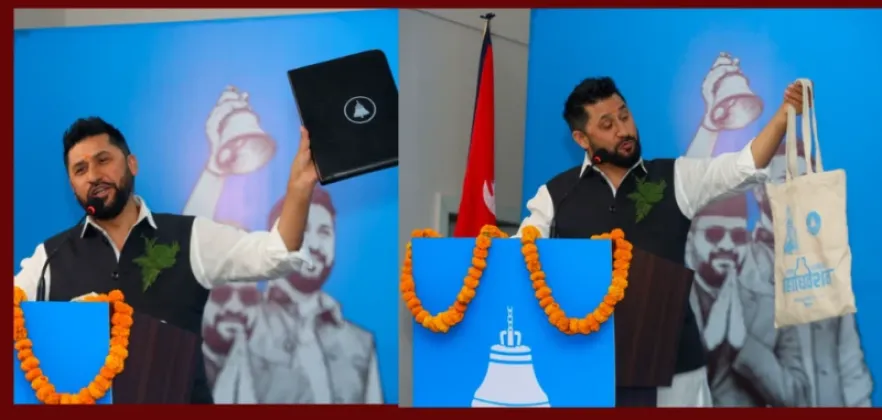
Rastriya Swatantra Party (RSP) Chairman Rabi Lamichhane on Saturday announced that his party will replace the traditional bag with files and smart diaries at its training sessions, conventions and other programmes. Speaking at the party's Karnali Province-level training programme in Surkhet, Lamichhane said the move is intended to free the RSP from the "jhole" (bag-carrying) political culture and carry it into what he called a "smart file" era. With the announcement, one of the most familiar objects of Nepali party politics has been singled out by the RSP chairman as a symbol of the political habits his party wants to leave behind.
From "jhole" to "smart file"
Addressing the training programme, Lamichhane said the RSP will do away with the bag in its events. In its place, files and smart diaries will be used at the party's training sessions, conventions and other programmes, he said. According to Pradesh Khabar, the RSP chairman presented the decision as a deliberate break with an entrenched habit, saying it aims to free the party from the "jhole" political culture and bring it into the "smart file" era.
The choice of venue gave the message a fitting stage. A province-level training is precisely the kind of party programme where bags have traditionally circulated in large numbers, and Lamichhane used the gathering in Surkhet to declare that the object itself will now be retired from RSP events. Rajdhani Daily and Nepal Views both reported the chairman's remarks from the Karnali programme.
The weight of the bag in Nepali politics
What the word "jhole" carries
The "jhole" occupies a peculiar place in Nepal's political vocabulary. In common usage, the word refers to the bag carried by activists and party followers, and by extension to the person who carries it: the ever-present aide who trails a leader with a bag in hand. Over the decades, the term has come to signify an entire culture of proximity politics, in which visibility beside a leader, rather than ideas or competence, is viewed as the surest route to favour within party structures.
By announcing that his party will swap bags for files and diaries, Lamichhane is taking aim at that imagery directly. The file and the diary suggest paperwork, preparation and record-keeping, while the bag, in the political imagination he invoked, evokes servility and the politics of patronage. The gesture is symbolic rather than procedural, but symbols of this kind have carried real weight in Nepali politics, and party chairmen rarely choose a provincial training platform to make an announcement of this nature.
Out of the "ghante and kharane" era
Lamichhane went a step further, describing the change as a step that takes the RSP out of the "ghante and kharane" era. In his framing, the phrase stands alongside the "jhole" as a marker of an older political age that the party is declaring itself finished with. Its replacement, the "smart file" era, is meant to signal a party that organises itself around information and ideas rather than around the materials of old-style mobilisation.
For a party that has built much of its public identity on setting itself apart from Nepal's established political forces, the language was consistent with its broader positioning. Lamichhane has repeatedly cast the RSP as an alternative to the practices of the traditional parties, and the retirement of the bag from party programmes now gives that argument a visible emblem, one that cadres will carry, quite literally, into every training hall and convention venue.
A message delivered from Surkhet
The announcement came as the RSP held its province-level training in Surkhet, the headquarters of Karnali Province. Delivering the message from Karnali, rather than from Kathmandu, placed it before the party's provincial cadres, the very people expected to put files and smart diaries to work in the programmes ahead. It also reinforced the sense that the party intends the change to apply across its organisational tiers, from central events to provincial gatherings.
Whether the shift changes habits inside the party will only be visible over time. The RSP's training sessions and conventions in the coming months will serve as the first test, where the absence of bags and the presence of files and smart diaries will be the most immediate, and most observable, measure of the chairman's promise. For now, Lamichhane has made clear how he wants his party to be seen: not as a queue of bag carriers, but as a workforce armed with files and diaries.