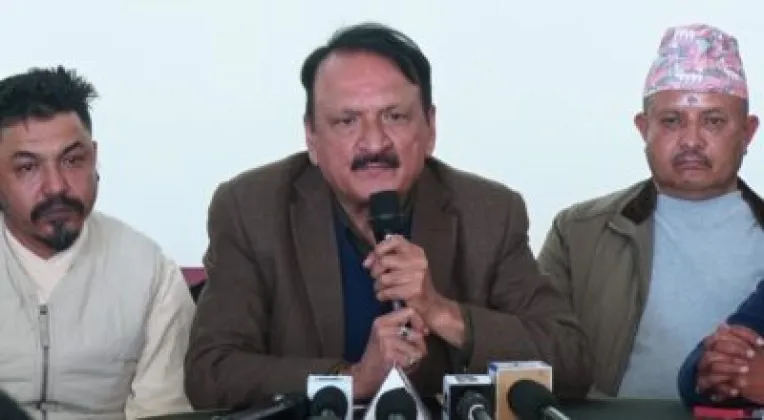
Kathmandu - Dr Prakash Sharan Mahat, coordinator of the publicity committee of the Nepali Congress Deuba faction's 15th central convention, said on Saturday that no one can stop the party from using its name, its flag and its tree election symbol. Addressing a press conference in Kathmandu, the senior Nepali Congress leader argued that the committee elected by the 15th convention is the party's official committee, and he referred to the committee elected by the 14th convention in pressing that claim. His remarks, reported by Khabarhub, Pradesh Khabar and Nepal Views, come at a sensitive moment for one of Nepal's principal political parties, which remains locked in an internal contest over who legitimately speaks in its name.
"No one can stop" the Congress identity, Mahat declares
At the heart of Saturday's briefing was a categorical message. Mahat maintained that no individual, faction or authority can bar the Nepali Congress from the use of the name, the flag and the tree election symbol that have long defined the party in public life. According to the reports, he framed the position in unambiguous terms: the use of the Congress name, flag and tree as an election symbol simply cannot be stopped.
He coupled that assertion with an organisational argument. In his telling, the committee elected by the 15th convention is the official committee of the Nepali Congress, and any claim to the contrary does not stand. Mahat, who coordinates the publicity committee of the Deuba faction's 15th central convention, used the press conference to place that position squarely before the public.
Key points from the press conference
- No one can bar the Nepali Congress from using its name, flag and tree election symbol.
- The committee elected by the 15th convention is the official one, according to Mahat.
- The committee elected by the 14th convention was cited as part of the foundation for that claim.
Two conventions, competing committees
The statement is best understood against the backdrop of the Nepali Congress's internal dispute over organisational legitimacy. The party's 14th convention produced a committee, while the Deuba faction's 15th central convention has elected a committee that the faction insists is the authentic representative body. The qualifier "Deuba faction" attached to the 15th convention itself underlines how contested the party's organisational space has become, and Mahat's decision to defend the convention's outcome publicly signals that the faction intends to press its claim rather than cede it.
His reference to the 14th convention committee is a notable element of the argument. By folding the earlier body into his case, Mahat appeared to present the 15th convention's committee not as a breakaway arrangement but as the legitimate continuation of the party's organisational line. In other words, the claim to officialdom rests not only on the 15th convention itself but on the chain of legitimacy that the 14th convention's committee represents.
For now, those two reference points, the 14th convention's committee and the 15th convention's committee, anchor the competing narratives inside the party. Saturday's briefing made clear which side of that line the Deuba faction's publicity apparatus stands on, and Mahat left little room for ambiguity about the faction's reading of the party statute and its conventions.
Why the name, flag and tree symbol matter
The emphatic defence of the party's identifiers reflects how much rides on them. In Nepal's electoral system, a party's registered name and its election symbol are central to how voters identify it at the ballot box, and the tree has served as the Nepali Congress's election symbol. The flag, meanwhile, is the party's most visible emblem, carried at rallies, conventions and public programmes across the country.
Any challenge to a party's ability to use its name and symbol would therefore strike at the core of its public and electoral identity. That is the context in which Mahat's statement, that no one can stop the use of the Congress name, flag and tree, should be read. It signals that the faction he represents is not prepared to concede ground on questions of identity even as the dispute over the party's committees continues.
What remains unsettled
Saturday's press conference clarified the Deuba faction's stance but did not resolve the underlying question of which committee will ultimately be accepted as the Nepali Congress's official central committee. Mahat's argument, that the 15th convention's committee is official, with the 14th convention's committee cited in support, now stands as the faction's formal position, articulated at a time when the party's internal contest remains live.
Until that broader dispute is settled, statements of this kind are likely to keep the contest over the party's leadership and identity in public view. For the moment, the message from the faction's publicity coordinator was direct: the Congress name, the Congress flag and the tree election symbol are not up for negotiation, and no one, in his words, can stop the party from using them.