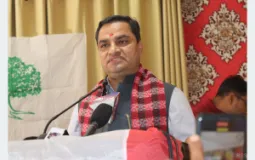
Rastriya Swatantra Party (RSP) chair Rabi Lamichhane said on Saturday that his party would continue to prioritise development in Karnali, despite receiving fewer votes and having weaker parliamentary representation in the province than in other parts of the country. Speaking at the opening of an RSP Karnali provincial training programme in Birendranagar, Surkhet, he acknowledged that the party’s result in last Falgun’s election fell short of expectations, but said development should not depend on electoral outcomes.
Acknowledging the party’s weak presence
Lamichhane recognised that the RSP had not established the level of electoral presence in Karnali that it had hoped for. He also noted that the party’s parliamentary representation from the province was weaker than its representation elsewhere. His remarks placed the election result in the context of the party’s broader challenge in the region: it has not secured the same political foothold in Karnali as in other provinces.
The party chair did not present the result as a reason to reduce attention to the province. Instead, he said Karnali’s development would remain a priority even where the RSP had received limited electoral support. The distinction was central to his message in Surkhet: a party’s commitment to development, he argued, should not be determined by how strongly voters have backed it at the ballot box.
His acknowledgment of the shortfall also recognised a gap between the party’s expectations and its performance. While the RSP’s parliamentary presence in Karnali is comparatively weak, Lamichhane’s statement signalled that the party intends to keep the province on its agenda rather than treat the election result as a measure of whether it deserves political attention.
Development not tied to election results
Lamichhane said development should not be tied to election results. That position frames development as an issue for the province regardless of whether a party has won significant support there. His remarks focused on the difference between electoral strength and the need to keep development a priority, rather than on any specific project or programme.
He also said the party’s voice had failed to reach Karnali’s remote areas. The comment points to a challenge in connecting the RSP’s message with people across the province, particularly beyond the areas where its presence is stronger. Lamichhane did not describe a new outreach plan in the remarks provided, but his acknowledgment made clear that the party sees its limited reach as part of the explanation for its weak position in Karnali.
The combination of these points - a result below expectations, weaker parliamentary representation and a voice that did not reach remote areas - gave the speech a candid tone. Lamichhane was not claiming that the RSP had already overcome those limits. Rather, he said the party would continue to regard Karnali’s development as a priority despite them.
Message delivered at provincial training programme
The remarks came as Lamichhane opened an RSP Karnali provincial training programme in Birendranagar, Surkhet, on Saturday. The programme brought the party chair to the province at a time when he was publicly recognising the RSP’s weaker electoral standing there. The event’s opening provided the setting for his message that the party’s commitment to Karnali should not be conditional on its vote share or parliamentary strength.
For the RSP, the statement sets out a distinction between political support and the party’s stated development priority. Lamichhane acknowledged that the party had not performed as expected in last Falgun’s election and that its representation from Karnali remained weaker than from other provinces. At the same time, he said the result would not change the importance the party assigned to the province’s development.
He also connected the party’s weak presence with its failure to make its voice heard in Karnali’s remote areas. That admission underscores the distance between the RSP’s political message and its reach across the province, without suggesting that the party has already closed that gap. Lamichhane’s stated position was that the shortfall should prompt recognition of the challenge, not a retreat from the province.
The central assurance from the RSP chair was that Karnali would remain a priority even though the party had received limited support there. His remarks offered no specific development commitments, but set out the principle guiding the party’s position: electoral strength should not determine whether a province’s development remains on its agenda.