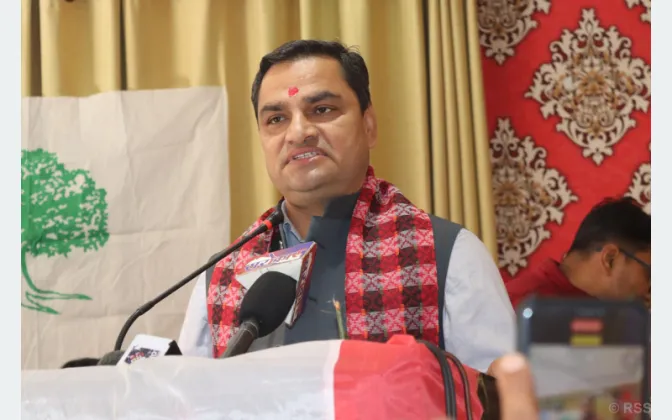
Nepali Congress General Secretary Pradeep Poudel on Saturday urged party leaders, cadres and all ranks of the organisation to unite and prepare together for the upcoming local-level elections, saying that unity within the party is necessary for the stability of democracy and for development. Speaking at a 'posting, congratulations and greetings' programme organised by the Nepali Congress Kathmandu Constituency No. 6 in Kathmandu, Poudel said the party's entire rank and file should now move ahead as one, with their attention fixed on the polls ahead. His appeal, reported by RatoPati and News of Nepal, came as the party has completed its ward and constituency-level internal elections, a process the general secretary said must now end in togetherness rather than division.
All party ranks called to unite for the local polls
At the heart of Poudel's address was a simple but pointed message: the Nepali Congress cannot walk into the local-level elections as a divided house. He called on all party ranks to unite and participate in the elections, positioning the polls as the immediate collective task before the organisation. Unity, in his telling, was not an abstract ideal but a practical requirement, one that he linked directly to the stability of democracy and to the broader agenda of development.
The choice of venue underscored the message. The programme, hosted by the party's Kathmandu Constituency No. 6, brought the general secretary face to face with cadres at the constituency level, the same grassroots layer that will be at the centre of the local election contest. Speaking there, Poudel framed the upcoming polls as a test that the party must prepare for together, with leaders and workers pulling in the same direction rather than holding on to the residue of internal competition.
The key messages from his address included:
- A call for all ranks of the party to unite and take part in the upcoming local-level elections.
- The argument that unity within the party is necessary for the stability of democracy and for development.
- The point that the recently completed internal election process should now give way to collective effort.
- The expectation that leaders and cadres begin preparing for the polls without delay.
From internal contests to collective effort
A substantial portion of Poudel's remarks dealt with the party's internal election process. He noted that ward and constituency-level elections of the Nepali Congress have already been completed, a milestone that has put refreshed structures in place across the organisation. With those contests now behind the party, he said the immediate responsibility is reconciliation: those who won should move forward together with those who lost.
The emphasis is significant. Internal elections, by their nature, create winners and losers within the same organisation, and disappointment from such contests can linger long after the results are announced. Poudel's message to both sides was that the outcome of internal polls should not define future cooperation. Victory, in his framing, carries the responsibility of taking everyone along, while defeat should not translate into distance from the party's work.
For a party heading into local-level elections, that reconciliation message carries practical weight. Local polls are contested at the ward level, precisely the tier where the recently completed internal elections were fought. If the committees that have emerged from those contests are to function as effective election units, the divisions of the internal process must first be set aside, which is exactly the spirit of the general secretary's appeal to the Kathmandu gathering.
Unity framed as a condition for democracy and development
Poudel did not present unity as merely an electoral tactic. He argued that cohesion within the party is necessary for the stability of democracy and for development, drawing a line from the condition of the Nepali Congress to the condition of the democratic system the party has long been associated with. In that framing, a united party is better placed to contribute to stable democratic practice, while internal discord weakens the broader project it seeks to serve.
The linkage also reflects the stakes of the upcoming local-level elections. Local governments form the tier of the state closest to citizens' daily needs, from local services to local development works, and the elections that constitute them are widely treated as a measure of each party's grassroots strength. For the Nepali Congress, performing well requires not only candidates and campaigns but functioning, united committees at the ward and constituency levels, the very structures the party has just renewed through its internal election process.
The Kathmandu programme therefore served a dual purpose. Organised by Constituency No. 6 as a 'posting, congratulations and greetings' event, it provided a constituency-level platform for the party's general secretary to deliver a mobilisation message directly to cadres, coupling the celebratory format with a serious political assignment for the weeks ahead.
As the local-level elections draw closer, Poudel's message from Kathmandu was unambiguous: the season of internal contests is over, and the task now is collective preparation. With ward and constituency-level elections completed, the Nepali Congress leadership is pushing its ranks to convert organisational renewal into unity, and unity into readiness for the polls. How thoroughly that appeal is absorbed at the grassroots will shape the party's footing as it moves into the election period.