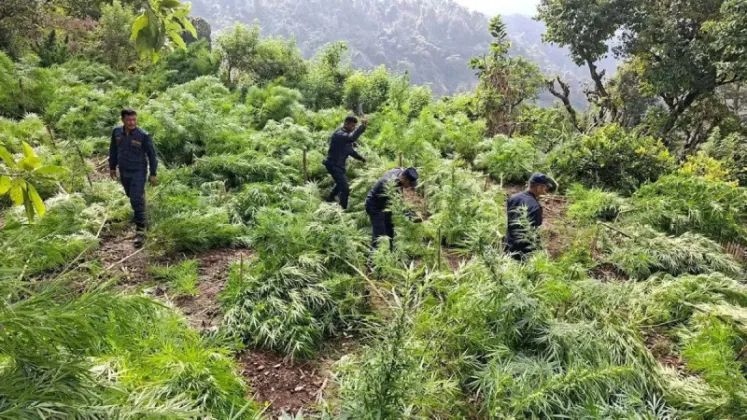
Security personnel in Udayapur district have destroyed thousands of illegally cultivated cannabis plants during the current fiscal year 2083/84, in a series of anti-narcotics operations carried out by the District Police Office and its subordinate units. The campaigns, conducted across different parts of the district, targeted marijuana grown illegally in forest and remote areas, as part of a broader crackdown on illegal cultivation.
According to OnlineKhabar, police destroyed more than 26,500 cannabis plants across the district during the fiscal year. Separately, The Himalayan Times reported that 5,100 marijuana plants were destroyed in a single operation in Katari Municipality-8 of the district.
Operations Across Forest Areas
The destroyed plants were found growing in forest areas, including Marjepur and other locations in the district, per The Himalayan Times. Cultivation of cannabis in such remote and forested terrain has long posed a challenge for law enforcement, as the plants are often grown far from settlements, making detection difficult.
The District Police Office, Udayapur, coordinated the campaigns through its subordinate units, deploying personnel to locate, uproot and destroy the illegal plantations. The operations were carried out as part of a crackdown on illegal cultivation, which police say remains a persistent problem in hill and forest regions of the district.
Part of a Wider Crackdown
The destruction of the plants forms part of ongoing efforts by Nepali police to curb the illegal cultivation of cannabis, which is prohibited under Nepali law despite the country's history with the crop. District-level police units regularly conduct such destruction campaigns, often with local administration involvement, to eliminate plantations before harvest.
The scale of this year's operations in Udayapur, with over 26,500 plants destroyed district-wide according to OnlineKhabar, highlights the extent of illegal cultivation in the area. The Katari operation alone, which saw 5,100 plants destroyed, underlines that individual plantations can be substantial.
Legal Context and Enforcement
Cannabis cultivation, sale and consumption are illegal in Nepal, although the country was once a noted destination for cannabis tourism before a nationwide ban in the 1970s. Enforcement has focused in recent years on destroying illicit plantations in rural districts, where illegal farming has continued in forested and remote areas.
Police in districts like Udayapur have continued to prioritise anti-narcotics campaigns, working through the District Police Office and area police units to identify and destroy crops. The current fiscal year 2083/84 campaigns in Udayapur represent the latest such effort, with thousands of plants removed from forest areas including Marjepur and Ah, per The Himalayan Times.
Further details on arrests or legal action connected to the destroyed plantations were not immediately available in the reports. Police campaigns of this nature are typically followed by monitoring of the affected areas to prevent replanting, as enforcement agencies work to deter cultivators from returning to the same forest tracts.
Ongoing Enforcement Efforts
The Udayapur operations reflect a wider pattern of anti-drug enforcement across Nepal, where police regularly report the destruction of cannabis plantations in Terai hill districts and forest regions. Such campaigns are often conducted ahead of the harvest season to maximise the impact on illegal supply chains.
With more than 26,500 plants destroyed district-wide this fiscal year, and significant single-site operations such as the 5,100 plants cleared in Katari Municipality-8, the Udayapur crackdown marks one of the more substantial anti-cannabis drives reported in the region. The District Police Office and its subordinate units have indicated that the operations were part of a continuing crackdown, suggesting further action may follow as the fiscal year progresses.