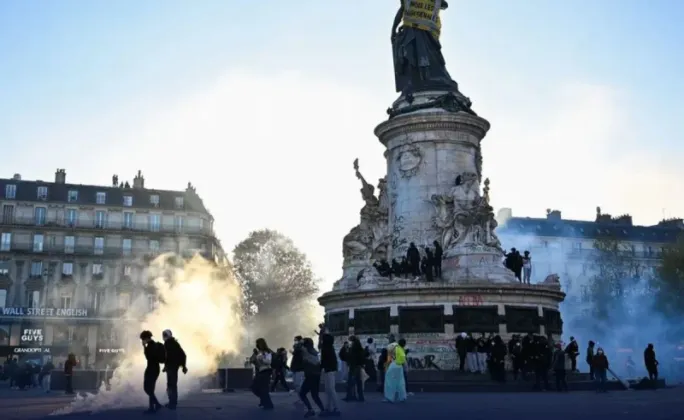
Paris police on Thursday imposed a ban on gatherings and protests in several sensitive and tourist areas of the French capital, citing the possibility of further demonstrations. The restrictions apply to locations including the Champs-Élysées, one of the city's most famous and most heavily visited thoroughfares. The order came just as French President Emmanuel Macron criticised US President Donald Trump, pairing a significant domestic security measure with a pointed political clash at the level of heads of state.
Restrictions in the heart of Paris
According to police, the ban covers both gatherings and protests across several areas of the capital that are considered sensitive or that attract large numbers of visitors. The Champs-Élysées is the most prominent location named, and the wording of the order makes clear that the measure extends beyond that single avenue to other parts of the city.
The key elements of the decision are as follows:
- Scope: Gatherings and protests are prohibited in several sensitive and tourist areas of Paris.
- Named location: The Champs-Élysées is among the restricted sites.
- Justification: Police cited the possibility of further demonstrations.
- Timing: The ban was announced on Thursday.
The decision places some of the city's most recognizable public spaces off limits to would-be demonstrators. The Champs-Élysées, lined with cafes, shops and landmark buildings, is a natural gathering point for crowds of every kind, and its inclusion in the restricted list underscores the seriousness with which police are treating the prospect of renewed protest activity. As Global Aawaj reported, police framed the measure as a response to the possibility that further demonstrations could take place.
Police brace for more demonstrations
The stated rationale for the order is the possibility of further demonstrations, language that suggests officials in Paris expect protest activity to continue rather than fade. Bans of this kind are typically used as a preventive tool: rather than waiting for crowds to assemble and then dispersing them, authorities move to stop assemblies from forming in the first place in the areas they consider most exposed.
What the ban means on the ground
The practical effect for the zones covered by the ban is immediate. Demonstrations and public gatherings cannot lawfully proceed there while the order is in force, and any group that attempts to gather would be acting in direct conflict with a police decision announced in advance. That reality applies not only to organised protest groups planning actions in the capital but also to more spontaneous gatherings, since the restriction covers gatherings as well as formal protests.
For residents and visitors, the order touches spaces that are normally among the busiest in Paris. The Champs-Élysées in particular functions as both a tourist magnet and a stage for French public life, hosting everything from national celebrations to major public festivities, which is precisely why its inclusion in the ban is significant. When authorities restrict assemblies on such a street, they are signalling that they view the areas in question as potential flashpoints.
A charged political backdrop
The security measure landed on the same day as pointed political comments from the French president. According to the report, Emmanuel Macron criticised Donald Trump, the US president, adding an international dimension to a day otherwise dominated by questions of domestic order in the French capital.
The juxtaposition is striking. A presidential criticism of a foreign head of state and a police order restricting assemblies across parts of the capital unfolded in parallel, and together they framed Thursday's news from Paris. The initial report did not draw a direct line between Macron's comments and the police decision, but the timing places the two developments side by side and lends both a heightened sense of consequence.
The substance of Macron's criticism was not detailed in the initial reporting. Even so, its arrival on the same day as the protest ban ensured that the French capital's news cycle combined domestic policing with high-stakes international politics, a combination rarely seen in a single day.
What happens next
With police explicitly citing the possibility of further demonstrations, the ban appears designed to keep pace with a fluid situation rather than to respond to a single fixed event. For now, the immediate reality for Parisians and tourists alike is that several of the capital's most famous spaces are closed to gatherings, with the restrictions in force as of Thursday.
The emphasis on further demonstrations indicates that authorities were bracing for continued protest activity, and the restricted areas are likely to remain focal points of attention in the days ahead. As the situation develops, further clarity is expected on the full scope of the restricted zones, on how long the ban will remain in place and on the reaction to Macron's comments from Washington.