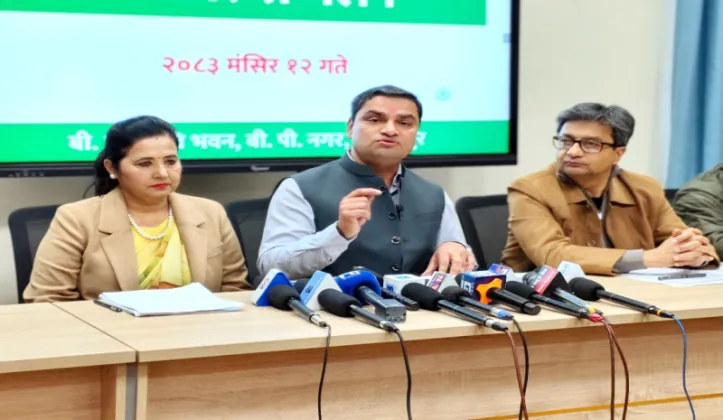
Kathmandu, November 28 - The Nepali Congress has formally decided to play the role of a strong and assertive opposition, issuing a blunt warning to the government over its working style, its violations of constitutional limits, its interference in the rule of law, and its neglect of the economy and the livelihood concerns of ordinary citizens. The decision was taken at a recent meeting of the party's central committee, which concluded that the government's recent activities reflect not mere inexperience or minor weaknesses but the thinking, character and tendency of its leadership. The meeting also served notice that the party would take action if its name, flag or election symbol is misused. The announcements were reported from Kathmandu on November 28.
A Formal Verdict from the Party's Highest Forum
The decision emerged from a recent gathering of the Nepali Congress central committee, the body that sets the party's political direction between its broader organizational assemblies. According to reports published by Gorkhapatra Online and Pradeshkhabar, the committee carried out a wide-ranging review of the government's conduct and came away with an unusually harsh assessment. Rather than limiting itself to routine criticism, the party chose to frame its opposition as a deliberate and organized role that it intends to play in the period ahead.
What stands out most in the committee's conclusion is its rejection of the idea that the government's problems stem simply from inexperience or small administrative missteps. In the party's reading, the conduct on display is not accidental. It reflects, in the committee's formulation as reported, the leadership's thinking, character and tendency. That language places responsibility squarely on those at the top of the government rather than on the teething troubles of a new administration.
The Charges: From the Constitution to the Kitchen Table
The central committee's warning rested on a set of specific grievances against the government:
- Working style: The party objected to the government's overall manner of functioning, portraying it as inconsistent with the responsibilities of high office.
- Violation of constitutional limits: The committee flagged what it described as breaches of the boundaries set by the constitution, presenting this as a matter of serious democratic concern rather than an ordinary political dispute.
- Interference in the rule of law: The party accused the government of interfering in legal processes and institutions, warning that such conduct erodes the foundations of accountable governance.
- Neglect of the economy: The committee criticized the government for failing to give the economy the attention and direction it demands.
- Livelihood issues: The party charged that the day-to-day concerns of citizens have been sidelined, even as pressures on household life continue to mount.
Taken together, these points formed the backbone of the party's decision to oppose the government more forcefully. The message from the committee was that its criticism will no longer be occasional or soft-spoken, but sustained and organized across all of these fronts, from constitutional conduct down to the cost of living and everyday livelihood questions.
Not Inexperience, Says the Party, but a Pattern
By stating plainly that the government's activities mirror the leadership's character and tendency, the central committee has drawn a sharp line under its earlier, more measured critiques. The framing matters politically: it signals that the party views the problems as inherent in the leadership rather than correctable through advice or patience. It also prepares the ground for a more combative posture, one in which each government decision is likely to be tested against the standards the committee has now publicly set out.
A Warning on Name, Flag and Symbol
Alongside its criticism of the government's conduct, the central committee turned to the party's own organizational identity. It warned of action if the Nepali Congress name, flag or election symbol is misused. These markers are how the party presents itself to voters and to the wider public, and the committee's language indicates a readiness to defend that identity against any unauthorized use. The warning was reported from Kathmandu on November 28 alongside the committee's political resolutions, giving the statement an organizational weight that ordinary comments from individual leaders rarely carry.
A Sharpened Stance Going Forward
The twin messages from the central committee, one aimed at the government and the other at anyone who might misuse the party's identity, point to a party preparing to harden its line. On the political front, the committee has committed the Nepali Congress to holding the government to account on constitutional conduct, the rule of law, and the state of the economy and livelihoods. On the organizational front, it has put potential violators of the party's symbols on notice that misuse will invite consequences.
For a party that has now chosen to define itself, in its own words, as a strong opposition, the central committee's statements set the tone for how that role will be played: firmly, publicly, and with an explicit warning that the government's conduct, in the party's judgment, goes far beyond teething problems. How the government responds, and whether it adjusts its style in the face of this pressure, will now shape the political conversation in the days ahead.