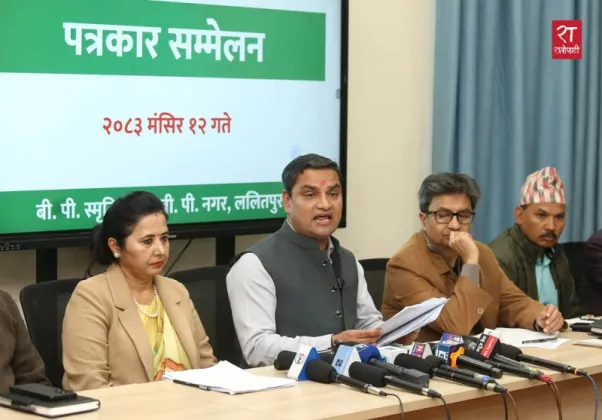
Kathmandu - The Nepali Congress has objected to Prime Minister Balendra Shah not raising the Nepal-India border dispute during his recent visit to India, accusing the Prime Minister of displaying a "double character" and describing his stance on border issues as immature and provocative. The criticism was voiced by party General Secretary Pradeep Paudel at a press conference held at the party's central headquarters in Sanepa on Saturday, convened to announce the decisions of the party's central committee. Paudel said it was objectionable that the Prime Minister did not raise the border dispute during the visit, even as the party separately welcomed the Indian cooperation and the air route that featured during the trip.
Objection raised at party headquarters
The press conference at the Sanepa headquarters was intended primarily to make public the decisions taken by the Nepali Congress central committee. However, it also became the platform from which the party delivered a pointed political message to the Prime Minister over his handling of the India visit. Speaking to journalists, General Secretary Pradeep Paudel said it was objectionable that the border dispute was not raised by the Prime Minister during the trip.
The choice of issue was not incidental. The border dispute is among the most sensitive subjects between Nepal and India, and the Congress made clear that it viewed the Prime Minister's silence on the matter as a serious lapse. By stating publicly that the omission was objectionable, the party has placed the issue squarely back on the political agenda. Paudel's remarks, delivered in his capacity as General Secretary at an official party press conference, carry the weight of the party's formal position rather than the personal view of an individual leader.
The party's key objections and positions, as outlined at the press conference, can be summarised as follows:
- It was objectionable that Prime Minister Balendra Shah did not raise the border dispute during his recent visit to India.
- The Prime Minister has displayed a "double character" in his conduct and messaging.
- His stance on border issues, both before and after taking office, was described as immature and provocative.
- At the same time, the party welcomed the Indian cooperation and the air route that featured during the visit.
Charge of "double character" and an "immature" stance
Beyond the specific complaint about the India visit, the Congress framed its criticism in sharper personal terms. Paudel accused the Prime Minister of displaying a "double character", a phrase that in Nepali political debate implies a contradiction between what a leader says publicly and what he actually does. The party paired this accusation with a direct assessment of the Prime Minister's approach, describing his stance on border issues, both before and after he took office, as immature and provocative.
Taken together, the language indicates that the party's grievance extends beyond a single omission on a single visit. The Congress is questioning the Prime Minister's overall credibility on border matters, arguing that his record does not match the positions he has projected publicly. That the charge was levelled at a press conference otherwise called to announce central committee decisions gives it additional weight, presenting the criticism as a deliberate, on-the-record position of the party rather than a passing remark.
Welcome for Indian cooperation and the air route
Importantly, the Congress paired its criticism with a note of appreciation. The party said it welcomed the Indian cooperation and the air route that featured during the Prime Minister's visit. This dual message is significant: it indicates that the party's objection is directed not at cooperation with India itself, but at the Prime Minister's failure to raise the border dispute and other sensitive issues while engaging with the southern neighbour.
By welcoming the cooperation and the air route while simultaneously criticising the omission of the border dispute, the Congress has sought to occupy a position that supports productive Nepal-India ties while insisting that unresolved and sensitive matters should be voiced at the highest level. In effect, the party's position suggests that goodwill and cooperation with India can go hand in hand with candour on the border question, and that the latter should not have been left unaddressed during a Prime Ministerial visit.
A criticism that frames the border debate
The exchange underscores how the border dispute continues to hold a central place in Nepal's political discourse, particularly when the country's leadership engages with India. For the Nepali Congress, the decision to raise the issue at a press conference otherwise devoted to organisational announcements reflects the importance the party attaches to it. The remarks were reported by RatoPati and Rajdhani Daily, both of which highlighted the party's twin approach of welcoming Indian cooperation while questioning the Prime Minister's silence on the border.
For now, the Congress's position stands as articulated by Paudel: the cooperation and the air route extended by India are welcome, but in the party's view, the border dispute and other sensitive issues should not have gone unmentioned at the level of the Prime Minister.