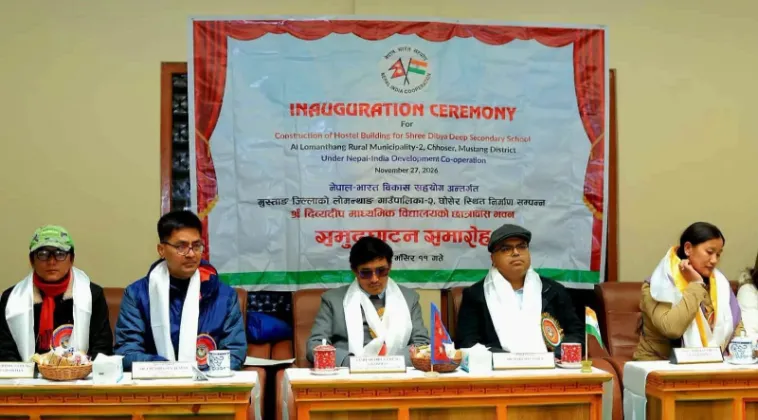
A newly built hostel building at Shree Divya Deep Secondary School in Lomanthang Rural Municipality-2, Mustang, was jointly inaugurated on Thursday, marking the completion of an education infrastructure project financed by the Government of India. The dormitory was constructed with Indian assistance under the High Impact Community Development Project and implemented through Lomanthang Rural Municipality. Dr. Rakesh Pandey, Deputy Chief of Mission at the Embassy of India in Kathmandu, and Lomanthang Rural Municipality Chair Tashi Nhurbu Gurung together opened the new building, according to reports by RatoPati and Himal Press.
Joint inauguration in Upper Mustang
The formal opening took place at the school in Lomanthang Rural Municipality-2, with the two dignitaries jointly inaugurating the facility. Dr. Rakesh Pandey represented the Indian side, while Tashi Nhurbu Gurung led the local government at the ceremony, as reported by both RatoPati and Himal Press.
The project was implemented through Lomanthang Rural Municipality, in line with the model followed under India's community development assistance, under which Nepali local governments execute community-level projects with Indian grant support. The joint presence of a senior Indian Embassy official and the rural municipality chair at the inauguration reflected the bilateral character of the initiative.
Project at a glance
- Facility: New hostel (dormitory) building
- Beneficiary school: Shree Divya Deep Secondary School
- Location: Lomanthang Rural Municipality-2, Mustang district
- Funding: Government of India, under the High Impact Community Development Project
- Implementation: Lomanthang Rural Municipality
- Inauguration: Joint ceremony on Thursday by Dr. Rakesh Pandey and Tashi Nhurbu Gurung
A product of India's High Impact Community Development Projects
The hostel is the latest example of the High Impact Community Development Project (HICDP) framework, a long-running component of India's development cooperation with Nepal. Under the scheme, the Government of India provides grant assistance for community-level infrastructure, typically in sectors such as education, health, drinking water and local connectivity, with projects delivered through Nepali local bodies.
Because HICDP projects are channeled through local governments such as rural municipalities, the approach is designed to keep execution at the community level, where local needs are identified directly. In the case of the Shree Divya Deep Secondary School hostel, Lomanthang Rural Municipality served as the implementing agency, overseeing construction of the dormitory through to completion.
Education infrastructure has been a consistent priority within this cooperation framework, with school buildings, classroom blocks and hostels featuring regularly among India-supported projects across Nepal. The Lomanthang hostel now joins that portfolio, and the participation of the Indian Embassy's Deputy Chief of Mission at the opening underlined the way both governments present such schemes as people-centric cooperation at the grassroots level.
Why a hostel matters in Lomanthang
Lomanthang lies in Upper Mustang, the trans-Himalayan northern belt of Mustang district in Gandaki Province, close to the border with China's Tibet region. The area is historically known for the walled settlement of Lo Manthang, the former capital of the old Lo kingdom, and today it combines a rich cultural heritage with the challenges of high-altitude, remote mountain living.
Settlements in the region are scattered across difficult terrain, and families often live at considerable distances from schools. In such circumstances, boarding accommodation is a significant part of the education system, and a hostel of this kind is expected to allow students from remote villages of the rural municipality to stay near their classrooms during the school term rather than making long daily journeys across the mountains.
Facilities of this nature are widely regarded as essential for keeping students enrolled and attending regularly in mountain districts like Mustang, where distances, weather and altitude can otherwise interrupt schooling. The new dormitory adds to the physical infrastructure available to Shree Divya Deep Secondary School, which serves students in Lomanthang and the surrounding settlements.
The facility opens a new chapter for the school
With the building formally inaugurated at Thursday's ceremony, the hostel is set to function as part of Shree Divya Deep Secondary School, operating under the oversight of the school and Lomanthang Rural Municipality. The joint inauguration by the Indian Embassy's Deputy Chief of Mission and the rural municipality chair brings the construction phase to a close and opens the way for the students the dormitory is intended to serve.
The project stands among the recent India-assisted development initiatives in Gandaki Province, and it adds to a wider pattern of cooperation in which community-level infrastructure in Nepal's hill and mountain local governments has been built with Indian grant assistance. Further operational details of the hostel, including its capacity and the schedule for student intake, were not included in the initial reports, which can be read in full at RatoPati and Himal Press.