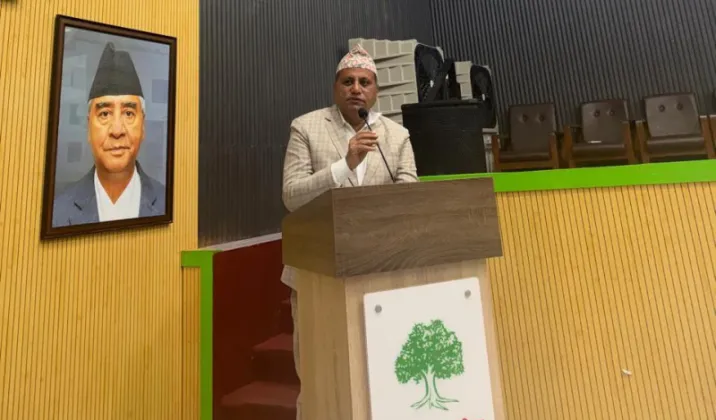
A prominent leader of the Nepali Congress has pressed the party to formally embrace the cause of restoring Nepal as a Sanatan Hindu state, adding a new dimension to the debate within the country's largest opposition party. Central member Bhim Parajuli raised the demand during the ongoing central committee meeting of the party, urging the leadership to adopt 'Omkar Parivar-sahitko Sanatan Hindu Rashtra' as an official agenda of the Nepali Congress.
Parajuli made the demand while speaking at the meeting, which was held in Biratnagar. According to reports in Nepali media, he argued that the issue of a Sanatan Hindu state should be advanced as a party agenda rather than left to individual leaders or informal discussion, framing it as a matter connected to Nepal's identity and heritage.
Parajuli's Argument: Civilization and Sanatan Tradition
In his intervention at the central committee meeting, Parajuli grounded his demand in what he described as Nepal's historical civilization and Sanatan tradition. He contended that the party should recognize and carry forward this heritage, positioning the demand for a Hindu state with the Omkar Parivar as an issue deserving formal consideration within the party's policy framework.
By invoking the Omkar Parivar, Parajuli's formulation goes beyond a simple call for the restoration of the Hindu state declared in the 1990 constitution and abolished after the 2006 people's movement and the subsequent peace process. The reference to the 'Omkar Parivar-sahitko Sanatan Hindu Rashtra' signals a broader civilizational framing that has been gaining currency among sections of Nepal's political and social leadership in recent years.
Context: The Hindu State Debate Within the Congress
The raising of the issue at the central committee level is significant for the Nepali Congress, a party that has historically defined itself as both democratic and socially progressive. While the party has not officially endorsed calls for reinstating Nepal as a Hindu state, voices within its ranks have periodically pushed for the party to take a clearer position on the question, particularly as public debate over secularism and national identity has intensified in recent years.
That such a demand was voiced at the central committee meeting, the party's top decision-making forum, in Biratnagar indicates that the issue is no longer confined to fringe discussions but is being placed squarely before the party's highest leadership. It remains to be seen how the party leadership responds to Parajuli's proposal and whether the demand will find a place in the Congress's agenda going forward.
What Happens Next
As of now, the Nepali Congress central committee meeting is ongoing, and no formal decision on Parajuli's demand has been reported. The proposal's fate will depend on the deliberations of the central committee and the leadership's assessment of how such a position would align with the party's constitution, its democratic credentials, and the secular provisions of Nepal's current constitutional order.
For observers of Nepali politics, the development underscores the growing traction of Sanatan and Hindu state discourse within mainstream parties. Whether Parajuli's demand becomes a formal party agenda item or remains an individual leader's position, its articulation at the central committee stage marks a notable moment in the ongoing conversation about Nepal's national identity.
This is a developing story, and further details regarding the party's response to the demand are expected as the central committee meeting continues in Biratnagar.