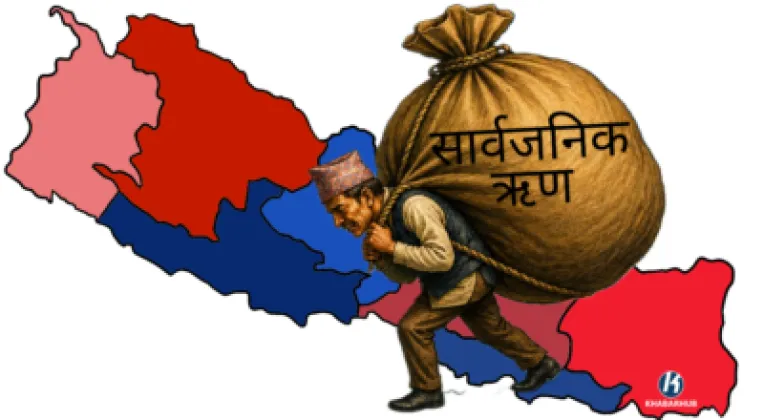
Nepal's total public debt liability has climbed to Rs 29 trillion 75 billion 11 crore 80 lakh (approximately Rs 2,975 billion) in the first four months of the current fiscal year 2083-84, according to a report released by the Public Debt Management Office (PDMO). The figures, which cover the period up to the end of the Nepali month of Kartik, place the country's debt burden at 45.08 percent of its Gross Domestic Product (GDP). The data was reported by multiple Nepali media outlets on November 25, 2026, highlighting the growing weight of public borrowing on the national economy.
Debt Composition and Scale
The Public Debt Management Office, the government body responsible for mobilizing and managing the country's public debt, compiles these figures as part of its regular reporting on Nepal's debt position. The total liability of Rs 29 trillion 75 billion 11 crore 80 lakh represents the accumulated outstanding obligations of the government, reflecting years of domestic and external borrowing used to finance the national budget and development spending.
Measured against the size of the economy, the debt now stands at 45.08 percent of GDP, a key indicator that policymakers and economists closely monitor to assess fiscal sustainability. The ratio is significant because it shows how much of the country's annual economic output is effectively matched by outstanding government liabilities. The PDMO's report up to Kartik end provides one of the clearest snapshots yet of the government's borrowing position in the current fiscal year.
A Rising Debt Trajectory
The latest figures confirm that Nepal's public debt has continued its upward trajectory in fiscal year 2083-84. Governments in Nepal have increasingly relied on borrowing, both from domestic sources such as treasury bills and development bonds and from external lenders, to bridge budget deficits and fund infrastructure projects. As a result, the Public Debt Management Office has become a central institution in tracking how these liabilities accumulate over the course of each fiscal year.
The four-month reporting window, running from the start of Shrawan to the end of Kartik, represents nearly a third of the fiscal year, and the debt level recorded at this stage indicates the pace at which the government has been adding to its obligations. The figure reported on November 25, 2026 by outlets including Khabarhub, Nagarik News and Ajako Artha underscores that debt accumulation remains one of the most closely watched aspects of Nepal's public finances.
Why the Debt-to-GDP Ratio Matters
The debt-to-GDP ratio is widely regarded as a benchmark for judging whether a country's borrowing is sustainable. At 45.08 percent, Nepal's public debt remains a central topic of fiscal discussion, as a rising ratio can constrain the government's ability to spend on priorities other than debt servicing. Economists typically watch this ratio because higher debt levels can crowd out productive investment, increase interest burdens, and expose the budget to greater risk if revenue collections fall short of targets.
For Nepal, where remittance inflows and tax revenue form the backbone of government income, the balance between borrowing for development and maintaining debt sustainability is a persistent policy challenge. The PDMO's regular disclosures, such as the report covering the period up to Kartik end of fiscal year 2083-84, are intended to give policymakers, lenders and the public a transparent view of where the country stands on this front.
What the Figures Mean Going Forward
With total liabilities now at Rs 29 trillion 75 billion 11 crore 80 lakh, the government enters the remainder of fiscal year 2083-84 carrying a substantial debt load relative to the size of the economy. The Public Debt Management Office is expected to continue publishing updates on the debt position as the fiscal year progresses, allowing observers to track whether the ratio moves further upward or stabilizes.
The current report, based on data up to Kartik end, serves as an important checkpoint in the fiscal calendar. As more of the year's borrowing program is implemented, the trajectory of the debt-to-GDP ratio beyond the 45.08 percent recorded in this report will be a key measure of the government's fiscal management in the months ahead. For now, the figures released on November 25, 2026 confirm that public debt remains one of the defining features of Nepal's economic landscape in the current fiscal year.