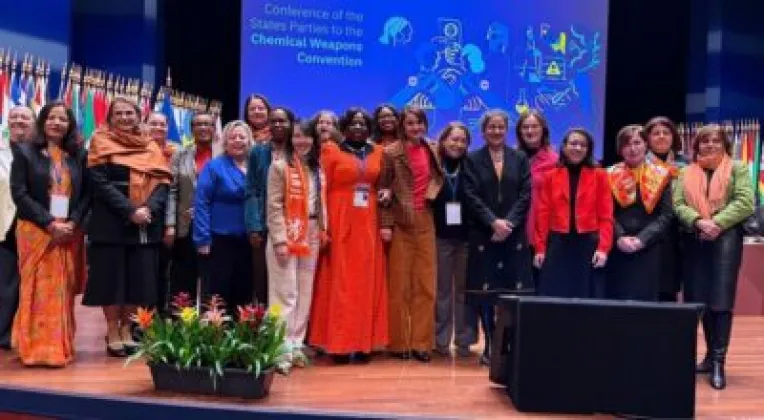
Nepal has reaffirmed its firm commitment to building a world free of chemical weapons, reiterating its pledge to fully implement the objectives and principles of the Chemical Weapons Convention. The commitment was expressed at the 31st session of the Conference of the States Parties to the Organisation for the Prohibition of Chemical Weapons (OPCW), held in The Hague, the Netherlands.
Addressing the session, Nepal's Ambassador to the Benelux countries and Permanent Representative to the OPCW, Sewa Lamsal, reiterated Nepal's pledge to the goals of the Convention, underscoring the country's consistent position on the complete elimination of chemical weapons worldwide.
Nepal's message at The Hague
The statement by Ambassador Lamsal at the Conference of the States Parties placed Nepal firmly among the countries supporting the global disarmament architecture built around the Chemical Weapons Convention. By speaking at the session, Nepal used the platform of the OPCW's foremost annual gathering to voice its support for the objectives and principles of the Convention, which aim to rid the world of an entire category of weapons of mass destruction.
As Nepal's Ambassador to the Benelux countries, Lamsal also serves as the country's Permanent Representative to the OPCW, making her the natural voice for Nepal at the organisation's headquarters in The Hague. Her address at the 31st session signals Nepal's continued engagement with the multilateral disarmament process even as a relatively small state in the global system.
The OPCW and the Chemical Weapons Convention
The Organisation for the Prohibition of Chemical Weapons, headquartered in The Hague, is the implementing body of the Chemical Weapons Convention, the international treaty that bans the development, production, stockpiling and use of chemical weapons and mandates the destruction of existing stockpiles. The Conference of the States Parties is the principal organ of the OPCW, bringing together member states to oversee the implementation of the Convention and to guide the organisation's work.
Nepal's participation in the 31st session of the Conference reflects its role as a state party to the Convention. For countries like Nepal, which do not possess chemical weapons programmes, engagement with the OPCW represents a commitment to the wider global norm against chemical weapons and to supporting the international institutions that verify compliance and respond to any use of such weapons.
Consistency in Nepal's disarmament diplomacy
Nepal's reaffirmation at The Hague is consistent with its long-standing posture in international disarmament forums. As a member of the United Nations and a party to key international instruments, Nepal has repeatedly positioned itself in favour of multilateralism, non-proliferation and the peaceful resolution of disputes. Its statement at the OPCW session adds the chemical weapons file to that record.
By pledging to fully implement the objectives and principles of the Chemical Weapons Convention, Nepal has aligned itself with the treaty's core bargain: that chemical weapons must never again be used and that a world free of them is both necessary and achievable. The reiteration of this pledge at the current session comes amid continued global attention to the status of the Convention's implementation and to instances of alleged chemical weapons use in various parts of the world.
What the commitment means
The pledge delivered by Ambassador Lamsal carries practical significance for Nepal's international standing. States parties to the Convention are expected to uphold the treaty's provisions, cooperate with the OPCW, and support its verification and capacity-building work. Nepal's reaffirmation indicates that it intends to continue meeting those expectations and to remain an active participant in the organisation's deliberations.
For a country whose foreign policy has traditionally emphasised non-alignment, international peace and cooperation through the United Nations, engagement at the OPCW is an extension of those priorities into the disarmament arena. Nepal's voice at The Hague contributes to the consensus-building culture that has defined much of the work of the Conference of the States Parties.
The reaffirmation also comes at a moment when the international community continues to weigh the effectiveness of the chemical weapons ban, making statements of support from state parties such as Nepal politically meaningful. By speaking at the 31st session, Nepal has signalled that it regards the Convention as a cornerstone of the global security order and its full implementation as a shared responsibility.
Looking ahead
Nepal's statement at the 31st session of the Conference of the States Parties to the OPCW is the latest demonstration of the country's commitment to international peace and security. With Ambassador Sewa Lamsal representing Nepal both to the Benelux countries and to the OPCW, Kathmandu has maintained a channel of direct participation in the treaty body charged with ridding the world of chemical weapons.
The pledge made in The Hague reinforces Nepal's alignment with the objectives and principles of the Chemical Weapons Convention and its support for a world in which chemical weapons are permanently eliminated. As the OPCW continues its work, Nepal has made clear that it stands with the community of states committed to that goal.
Sources: Khabarhub, Ratopati, Ajako Artha