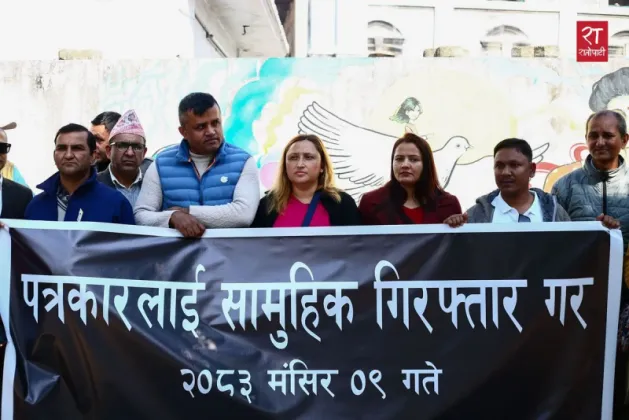
The Nepal Press Council staged sit-in protests at multiple locations across the Kathmandu Valley on Wednesday, demanding the mass arrest of journalists. The demonstrations, held under the slogan "Arrest journalists all at once, not again and again," were organised as part of the Council's ongoing campaign pressing for the collective arrest of working journalists.
The protests moved through three different sites in quick succession, beginning at the District Administration Office in Lalitpur at 9 am, proceeding to the District Administration Office in Bhaktapur at 10 am, and concluding in front of the Department of Roads at Babarmahal at 11 am.
A relay of protests across three districts
The Council chose a rolling format for Wednesday's actions, holding sit-ins one after another at three prominent government locations within the Kathmandu Valley. The sequence began in Lalitpur, where Council members gathered at the District Administration Office in the morning. An hour later, the protest shifted to the neighbouring district of Bhaktapur, with demonstrators assembling outside the District Administration Office there at 10 am.
The final sit-in of the day was staged at Babarmahal, where the Council pitched its protest directly in front of the Department of Roads, a high-visibility location along one of Kathmandu's busiest corridors. According to reports, the demand at each site was the same: journalists should be arrested collectively rather than detained one by one.
"Arrest journalists all at once"
The slogan carried by the protesters, "Arrest journalists all at once, not again and again," became the defining message of Wednesday's events. The phrasing of the demand, which openly calls for the detention of members of the press as a group rather than individually, has drawn attention precisely because of how unusual it is for a body associated with the press to make such a call.
The Council described the sit-ins as part of its broader "campaign" demanding the collective arrest of journalists. No further specifics about the campaign's origins or wider demands were provided in the available reporting, but organisers made clear that the Wednesday actions were one element of a sustained effort rather than a one-off demonstration.
What the sit-ins looked like
Photographs from the protests show Council members seated together at the protest sites, with banners and placards bearing the campaign's central slogan. The sit-ins were held during working hours, with the schedule deliberately staggered through the morning, from 9 am in Lalitpur through to the Babarmahal action at 11 am.
The choice of venues, two district administration offices and the headquarters of a key government department, placed the protests directly in front of state administrative infrastructure in all three cases. The demonstrations were confined to the Kathmandu Valley, with no sit-ins reported elsewhere in the country on the day.
Unusual demand draws attention
The nature of the demand has made the protests noteworthy. Press freedom organisations and journalists' federations in Nepal typically campaign against the arrest and detention of journalists, and calls for the mass arrest of members of the press from a body organising under the press banner represent a striking inversion of the usual dynamic. The Council, however, presented its demand without ambiguity, and the slogan was reported verbatim by multiple outlets covering the events.
Reports covering the sit-ins were published with photo coverage, documenting the scenes at the District Administration Office in Lalitpur, the District Administration Office in Bhaktapur and the Babarmahal protest site.
A campaign in motion
Organisers indicated that Wednesday's triple sit-in was conducted under the framework of the Council's campaign for the collective arrest of journalists. By rotating the protest through three districts in a single morning, the Council signalled an intent to maintain visibility across the Valley rather than concentrate its action at a single location.
The full schedule, 9 am at Lalitpur's District Administration Office, 10 am at Bhaktapur's District Administration Office, and 11 am at Babarmahal in front of the Department of Roads, was confirmed by outlets covering the protests. The Council's demand for mass arrests of journalists, and the campaign built around it, now stands as the central public message emerging from Wednesday's actions.
No official reaction from the government bodies targeted by the protests, or from journalists' organisations responding to the demand, was included in the reporting available at the time of writing. Further actions under the Council's campaign, if planned, have not yet been announced publicly.
For now, Wednesday's sit-ins stand as the most visible expression yet of the Council's campaign, delivering its singular, provocative demand, that journalists be arrested all at once rather than one at a time, directly to the doorsteps of district administrations in Lalitpur and Bhaktapur, and to the federal bureaucracy at Babarmahal.