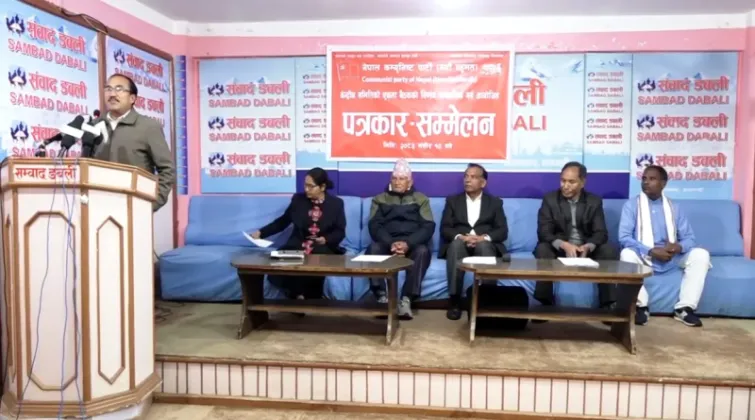
The Nepal Communist Party (New Majority) has formally decided to adopt a collective leadership system, in a significant organisational move following the formation of the party through the merger of two communist outfits. Coordinator Dhamendra Bastola made the decision public on Thursday after it was endorsed at a full meeting of the party held in Kathmandu.
The party, led by Dhamendra Bastola, emerged after the merger of the Nepal Communist Party Majority and the Nepal Communist Party Janapaksha, with the two parties reorganising themselves under the new banner of Nepal Communist Party (New Majority). The adoption of a collective leadership system marks the first major structural decision taken by the unified party since its formation.
Merger Forms New Communist Party
The decision to move towards collective leadership comes directly in the wake of the unification process between the Nepal Communist Party Majority and the Nepal Communist Party Janapaksha. Rather than consolidating authority in a single leader, the newly reorganised party has chosen a model in which leadership responsibilities are shared among a group of senior office bearers.
Coordinator Dhamendra Bastola, who heads the party in its new form, shared the decision with the public after the full meeting concluded in Kathmandu. The announcement, made public on Thursday, signals the party's intent to operate on the principle of shared responsibility as it begins its journey as a unified political force.
Decision Taken at Full Meeting in Kathmandu
The choice of a collective leadership system was reached at a full meeting of the party convened in the capital. Full meetings of this nature typically bring together the party's senior leadership and key members to deliberate on organisational matters, making the Kathmandu gathering the platform where the new party charted its immediate course.
By taking such a foundational decision at its first full meeting, the Nepal Communist Party (New Majority) has moved quickly to define how it will function internally. The collective leadership arrangement will now guide the party's decision-making processes going forward.
What Collective Leadership Means for the Party
Under a collective leadership system, key decisions and party responsibilities are distributed among multiple leaders rather than being concentrated in one individual. For a party that has just come into being through the merger of two separate organisations, such an arrangement can help balance the interests and expectations of members from both the former Nepal Communist Party Majority and the former Nepal Communist Party Janapaksha.
The decision reflects a broader practice seen among communist parties, where collective leadership has historically been emphasised as a guiding organisational principle. By adopting this system at the outset, the Nepal Communist Party (New Majority) under Dhamendra Bastola has signalled that shared leadership will be central to its political identity.
Looking Ahead
With the merger complete and the leadership structure decided, the Nepal Communist Party (New Majority) has laid the groundwork for its operations as a unified entity. The public announcement of the collective leadership system on Thursday marks the first step in consolidating the merger between the two parties.
Further details regarding the party's broader organisational structure, office bearers and political direction are expected to become clearer as the newly formed party settles into its collective leadership model. For now, the party's immediate focus, as reflected in the Kathmandu full meeting, has been on establishing the framework through which it will govern itself and make decisions as one organisation.
The formation of the Nepal Communist Party (New Majority) and its adoption of collective leadership represent a notable development within Nepal's communist political landscape, where mergers and splits among like-minded parties have been a recurring feature. How the new arrangement functions in practice will be closely watched as the party moves ahead under the coordination of Dhamendra Bastola.