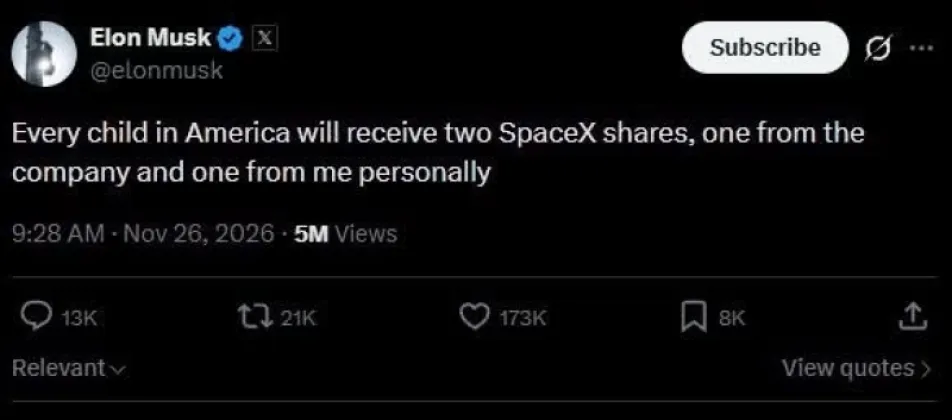
Elon Musk, the chief executive of SpaceX and one of the world's most prominent technology entrepreneurs, has announced that every American child will receive two shares of SpaceX, in a surprise declaration that has drawn widespread attention. The announcement was reported by Nepali news outlets Baahrakhari and Nepal Lead on 26-27 November 2026, and quickly circulated as one of the most talked-about statements from the billionaire in recent months. The move connects themes of science, the economy and education, with commentators noting the unusual nature of a private company pledging ownership stakes directly to the children of an entire nation.
The reports, however, stopped short of providing any operational details. No information was given on eligibility criteria, how children would be identified and registered, when the shares would actually be distributed, or what legal mechanism would be used to transfer ownership of a privately held company's equity to millions of minors. This absence of specifics has left many questions unanswered even as the announcement continues to generate headlines.
What Was Announced
According to the coverage published by Nepal Lead and Baahrakhari, Musk stated that each American child would be entitled to two shares of SpaceX. The statement was framed as a direct benefit to the younger generation, tying the future of one of the most valuable private space companies in the world to children across the United States.
SpaceX, founded by Musk in 2002, is not a publicly traded company. Its shares are held by private investors, employees and Musk himself, which makes any proposal to distribute equity to the general public, let alone to children, a matter of significant complexity. Neither Musk nor SpaceX, per the reported coverage, offered clarification on how such a distribution would work in practice. The reports did not indicate whether the shares would be handed out immediately, placed in trust until the children reach adulthood, or tied to any future public listing of the company.
Why the Announcement Stands Out
The announcement is notable for several reasons. First, SpaceX is among the most valuable private companies in the world, with its valuation shaped by its dominant role in commercial satellite launches through its Falcon rockets, its rapidly expanding Starlink satellite internet business, and its contracts with NASA and the United States military. Two shares in such a company, even if the ultimate value depends entirely on how the company is valued and structured, would represent a tangible asset in the hands of ordinary families.
Second, the gesture links the themes of science and the economy in a way that few corporate announcements do. By speaking directly to children, Musk appeared to be positioning SpaceX not merely as a commercial venture but as something belonging, at least in part, to the next generation. The coverage also cited education as a related theme, suggesting the announcement was understood not only as a financial promise but as a message about inspiring young people toward science, technology and space exploration.
Musk has a long history of making sweeping public statements about the future of humanity, space colonization and technological progress, and his pronouncements frequently move markets and dominate news cycles. This latest declaration follows that pattern: broad in vision, striking in its simplicity, and light on implementation details.
The Questions Left Unanswered
While the headline promise is straightforward, the practical questions surrounding it are considerable. The reports did not specify:
- How eligible children would be identified or verified
- Whether the offer applies to all children in the United States or only certain groups
- Whether the shares would carry voting rights or dividends
- How a private company's equity could be legally transferred to minors
- What timeline would govern the distribution
Because SpaceX is privately held, its shares are not traded on any public exchange, and transferring ownership to a large population would require corporate restructuring, regulatory review and considerable legal groundwork. None of these steps were described in the reported coverage. Until further clarification comes from Musk or the company, observers are left to treat the announcement as a statement of intent rather than a fully formed programme.
Background: Musk and SpaceX
Elon Musk founded SpaceX just over two decades ago with the goal of reducing the cost of space transportation and, ultimately, enabling human life on other planets. The company has since become the leading commercial launch provider in the world, developed the partially reusable Falcon 9 rocket, and built the Starlink constellation, which provides satellite internet service to millions of users globally. Musk also leads Tesla and has been involved in other ventures, making him one of the most closely watched figures in global business and technology.
His public statements routinely attract global attention, and announcements involving SpaceX equity carry particular weight because the company's valuation has grown dramatically over the years. Any suggestion that ordinary families, and specifically children, might hold a stake in that growth is therefore certain to be scrutinized closely by investors, regulators and the public alike.
What Comes Next
As of the reporting on 26-27 November 2026, no follow-up details had emerged regarding the mechanics of the pledge. The announcement, as carried by Baahrakhari and Nepal Lead, stands as an ambitious statement linking the fortunes of a leading space company to America's children, combining the promise of economic benefit with an implicit appeal to education and scientific ambition. Whether the plan moves from announcement to implementation, and in what form, remains to be seen. Further clarification from Musk or SpaceX on eligibility, timing and structure will be essential in determining whether this pledge becomes a reality or remains one of the entrepreneur's trademark bold visions.
For now, the statement has succeeded in doing what Musk's announcements often do: sparking conversation about the intersection of technology, wealth and the future that today's children will inherit.