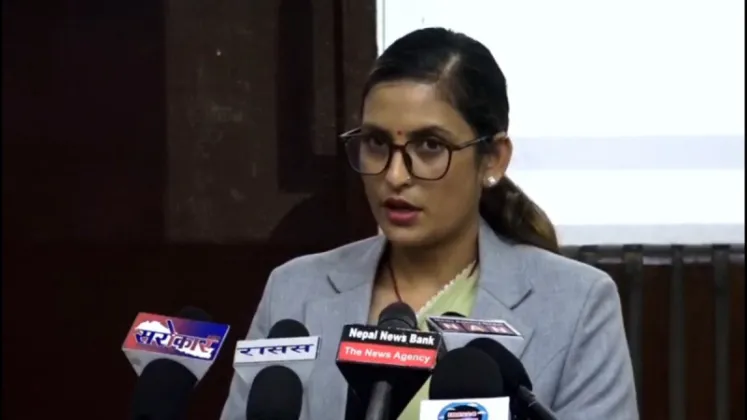
Lalitpur, November 25, 2026 - Minister for Women, Children, Gender and Sexual Minorities and Social Security Sita Wadi has stressed that children deprived of parental protection should be raised in family-based alternative care rather than in institutional arrangements. She said the family system serves the best interests of children and should be prioritized whenever alternative care is needed.
The Minister made these remarks while addressing a national interaction on the International Classification of Activities for Alternative Care of Children (ICARE), organized jointly by the National Statistics Office and UNICEF in Lalitpur on November 25, 2026.
Family-Based Care in the Best Interests of Children
Speaking at the interaction, Minister Wadi said that institutional arrangements, such as care homes and children's homes, should give way to family-based alternative care for children who have been deprived of parental protection. She emphasized that the family environment is the most appropriate setting for a child's upbringing and development, and that care for orphaned and vulnerable children should therefore be anchored within the family system.
According to the Minister, prioritizing family-based care aligns with the best interests of the child, a principle that guides policy and practice in child protection. She indicated that the state's approach to children without parental care should move away from institutionalization and toward arrangements that keep children connected to a family environment.
National Interaction on ICARE Classification
The event where the Minister expressed these views was a national interaction focused on the International Classification of Activities for Alternative Care of Children, known as ICARE. The interaction was organized by the National Statistics Office in collaboration with UNICEF, the United Nations Children's Fund, and took place in Lalitpur.
The ICARE classification is an international framework used to categorize activities related to the alternative care of children. Such classifications support countries in generating consistent data on how children without parental care are looked after, whether through kinship care, foster care, or residential institutions. The National Statistics Office's involvement reflects the role of official statistics in understanding and improving the country's alternative care systems, while UNICEF's participation underscores the agency's long-standing engagement in child protection issues in Nepal.
Policy Direction for Child Protection
Minister Wadi's remarks come at a time when the question of how Nepal cares for children without parental protection is receiving renewed attention within government policy discussions. Her position, as stated at the interaction, is clear: the family system should be the priority in caring for orphaned children, and institutional care should not be the default option.
The Ministry the Minister leads is responsible for matters concerning women, children, gender and sexual minorities, and social security, making child welfare policy a central part of its mandate. Her comments at the ICARE interaction signal the government's intent to align its child care practices with the principle that children grow best within families.
Data and Collaboration With UNICEF
The organization of the national interaction by the National Statistics Office with support from UNICEF highlights the importance both institutions place on data-driven approaches to child protection. The ICARE framework is intended to help countries classify and measure activities related to alternative care, providing a common standard for understanding the scale and nature of care arrangements for children deprived of parental protection.
By bringing together the statistical authority and the United Nations children's agency, the interaction in Lalitpur aimed to strengthen the evidence base around alternative care in Nepal. Such evidence is essential for shaping policies that can shift the balance of care from institutions to family-based solutions, in line with the direction articulated by Minister Wadi.
The Broader Context of Alternative Care in Nepal
Children deprived of parental protection in Nepal include those who have lost their parents, as well as those separated from their families for other reasons. For decades, residential care homes have played a significant role in providing for such children, but international child welfare standards increasingly emphasize that institutionalization should be a measure of last resort, used only when family-based options are not available or appropriate.
The position taken by Minister Wadi at the national interaction is consistent with this broader international understanding, which holds that growing up in a family supports children's emotional, social, and educational development better than growing up in an institution. Her statement that institutional arrangements should give way to family-based alternative care points toward a policy emphasis on kinship care, guardianship within extended families, and other family-centered solutions.
The national interaction on ICARE in Lalitpur on November 25, 2026, organized by the National Statistics Office and UNICEF, provided the platform for this policy message. As the government and its partners work to classify, measure, and improve alternative care arrangements for children, the Minister's remarks signal that the family system will remain at the heart of Nepal's approach to protecting children deprived of parental care.
Further details about the outcomes of the interaction and any resulting policy measures have not yet been made available. The remarks by Minister Wadi, however, mark a clear statement of the government's preferred direction: children without parental protection are best served when they can grow up within a family.