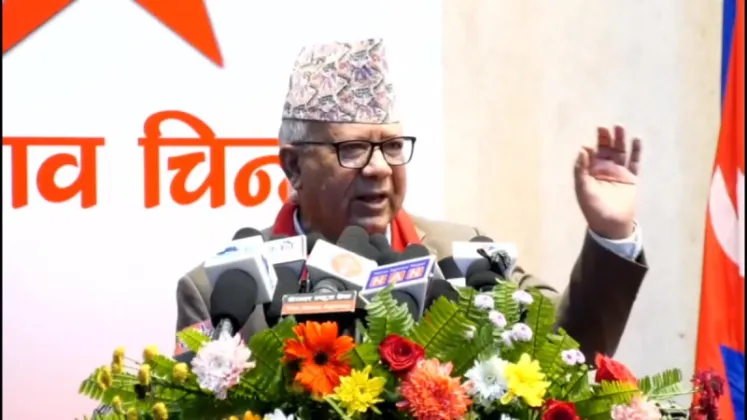
KATHMANDU - Former prime minister Madhav Kumar Nepal, co-chair of the Nepali Communist Party, said on Saturday (November 28) that Nepali soil must not be allowed to serve as a base for military activity by any foreign power against the country's neighbours. Addressing an event in the capital, he warned that Nepal's nationality was in crisis, claimed that foreign powers were casting a crooked eye on the country, and urged the leaders and cadres of his party to remain aware and vigilant on the issue, as reported by Ratopati and News of Nepal.
Nepali soil must not become a base against neighbours
At the centre of Nepal's address was a categorical demand: the territory of Nepal should not be used, by anyone, as a staging ground for military action directed at neighbouring countries. The statement, delivered at a gathering in Kathmandu, was framed not as a comment on any single relationship but as a blanket principle covering all foreign powers, according to reports of his remarks.
The key points from the former prime minister's intervention were:
- Territory: Nepali soil must not be used by any foreign power as a base for military activity against neighbouring countries.
- Sovereignty: Nepal's nationality is in crisis, he claimed.
- External attention: Foreign powers are casting a crooked eye on the country, he said.
- Party message: Leaders and cadres of the Nepali Communist Party have been urged to stay aware and vigilant on the issue.
The position he articulated has deep roots in Nepal's approach to the world. Situated between India and China, the country has long maintained that friendship with both neighbours, and freedom from their rivalries, is the surest guarantee of its security. Nepal's intervention underscores that, in the view of senior political figures, this remains a red line that stands above day-to-day political differences.
Nationality in crisis, foreign eyes on Nepal
Beyond the question of military bases, the former prime minister painted a broader and more alarming picture. He claimed that Nepal's nationality itself is in crisis, and that foreign powers are casting a crooked eye on the country. In Nepali political vocabulary, the phrase suggests covetous, watchful interest from outside, a sense that others are eyeing the country's land, resources or strategic position with designs that fall short of open hostility.
By linking the two warnings, Nepal connected the physical and the political dimensions of sovereignty. The danger, in his framing, is not only that foreign militaries might seek footing on Nepali soil, but that the country's very identity as an independent nation is under strain. It is a formulation intended to sharpen attention rather than to describe a specific incident; the reports of his speech do not point to any particular country or episode.
A call for vigilance inside the party
Significantly, Nepal directed his message inward as much as outward. He urged party leaders and cadres to remain aware and vigilant on the issue, indicating that he sees the question of foreign activity on Nepali soil as one requiring organized political attention within his own ranks rather than a passing remark from a podium, as News of Nepal reported.
The event in Kathmandu, attended by the party's leaders and cadres, provided the setting for that appeal. By speaking to this audience, the co-chair effectively made the defence of Nepali territory and nationality a task for his cadres, something to be watched, discussed and acted upon at every level of the party, from the central leadership down to local units.
The weight of a former prime minister's words
Nepal's standing lends the statement its force. A former prime minister and co-chair of the Nepali Communist Party, he belongs to the senior generation of the country's communist movement, and his views on foreign affairs continue to carry weight both within his party and in the wider political conversation in Kathmandu.
His insistence that Nepali land should not become a military base against neighbours echoes a commitment that successive governments in Kathmandu have repeated over the years, namely that Nepal will not allow its territory to be used against either of its neighbours and expects equal consideration in return. The warning that the country's nationality is in crisis adds a sharper, more urgent note to that familiar line, reflecting the anxieties that a small country between large powers must continually manage.
For now, the remarks stand as a clear public statement of principle from a senior figure: Nepali soil is not available for anyone else's military purposes, and the party he co-chairs has been told to keep watch on exactly that.