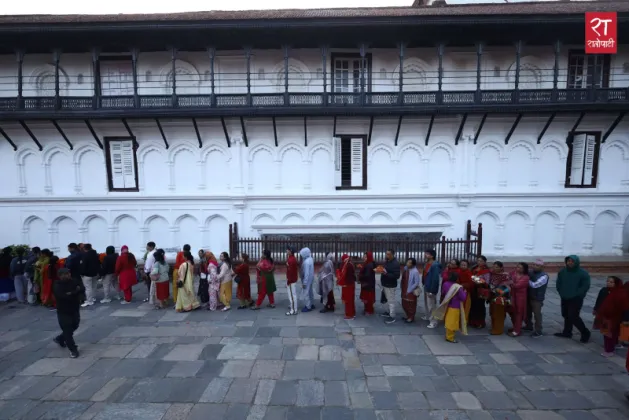
The living goddess Kumari received darshan of Taleju Bhawani at Hanuman Dhoka in Kathmandu on Tuesday night, in a traditional ceremony conducted with tantric and Vedic rituals. Kumari was brought from Kumari Ghar to the Taleju premises in a chariot procession, while the idol of Taleju Bhawani was moved from the temple to the main courtyard for the ritual meeting. According to tradition, receiving darshan of Taleju Bhawani is believed to grant divine power.
Ritual meeting at Hanuman Dhoka
The ceremony brought together Kumari, the living goddess, and Taleju Bhawani, whose idol was taken from the temple and placed in the main courtyard. The meeting followed a traditional sequence: Kumari travelled from Kumari Ghar in a chariot procession, and the goddess’s idol was brought out to the courtyard. The darshan was then conducted using tantric and Vedic rituals.
The movement of both figures between their respective locations and the courtyard formed the central part of the event. Kumari’s journey began at Kumari Ghar, while Taleju Bhawani’s idol was moved from the temple. The two were brought to the Taleju premises for the observance, which took place at night.
The ceremony’s setting at Hanuman Dhoka placed the ritual within the Taleju premises in Kathmandu. The main courtyard served as the location for the darshan after the idol was moved from the temple. The account of the event describes the procession and the ritual meeting as parts of the same traditional observance.
A tradition associated with divine power
The darshan carries religious significance in the tradition described around the ceremony. It is believed that receiving darshan of Taleju Bhawani grants divine power. The belief gives meaning to the meeting between Kumari and the goddess’s idol, which was brought from the temple into the courtyard for the occasion.
The ceremony combined tantric and Vedic rituals, according to the reports. These ritual elements accompanied the darshan on Tuesday night. The available details do not specify further stages of the rites, but identify the ritual forms and the traditional belief associated with the meeting.
Kumari was brought to the Taleju premises from Kumari Ghar in a chariot procession, and the idol of Taleju Bhawani was moved from the temple to the main courtyard. Together, those movements made the courtyard the setting for the darshan. The event was described as a traditional observance, with the belief in divine power tied to receiving the goddess’s darshan.
The ceremony concluded the described sequence of the night: the procession from Kumari Ghar, the movement of Taleju Bhawani’s idol from the temple, and the ritual meeting at Hanuman Dhoka. Its central observance was the darshan of Taleju Bhawani by the living goddess Kumari, carried out according to tradition.