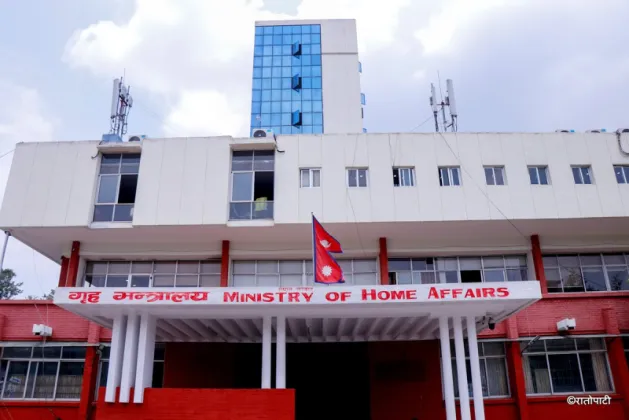
The Ministry of Home Affairs has directed all District Administration Offices across Nepal to provide relief promptly to the families of persons who have gone missing in monsoon-related disasters, instructing that such families be treated on par with the families of the deceased. The directive was issued through an official circular on Monday, as the country continues to grapple with the aftermath of monsoon-season disasters.
Circular grounded in existing guidelines
The circular cites the Disaster-Sensitive Social Security and Relief Distribution Guidelines, 2081, as the legal and procedural basis for the directive. Under these guidelines, relief distribution is meant to reach disaster-affected people in a manner that is timely, fair and sensitive to the needs of vulnerable groups.
By explicitly referencing the 2081 guidelines, the Ministry has clarified that the provisions applying to the families of those killed in disasters also extend to the families of the missing. In practical terms, this means that the absence of a body or a formal death certificate should not become an obstacle for families waiting for relief assistance.
Prompt relief without delay
The core instruction of the circular is that eligible family members of missing persons must receive relief without delay. District Administration Offices, which serve as the primary disaster-response authorities at the district level, are expected to act on the directive immediately rather than waiting for prolonged verification processes.
This is significant because families of missing persons have often faced procedural uncertainty. When a person swept away by floods or landslides is not found, families may be left in limbo, unsure whether they qualify for relief designated for the deceased. The Ministry's directive aims to remove that ambiguity by placing missing persons in the same category as the deceased for relief purposes.
Context: monsoon disasters in Nepal
The directive comes at a time when monsoon-related disasters, including floods and landslides, remain a recurring and deadly feature of the rainy season in Nepal. Such incidents frequently result in deaths as well as people going missing, with bodies sometimes never recovered from swollen rivers or buried debris.
Relief distribution in the aftermath of these disasters falls largely to District Administration Offices, working with local governments and security agencies. The Ministry of Home Affairs, as the central body overseeing disaster management and internal security, routinely issues directives to coordinate and speed up the response. Monday's circular fits within that framework, ensuring that the administrative machinery at the district level applies the 2081 guidelines consistently.
What the directive means for affected families
For the families of the missing, the circular offers a clearer and faster route to assistance:
- Families of persons missing in monsoon-related disasters are to be treated as eligible for relief on the same basis as families of the deceased.
- District Administration Offices have been explicitly instructed to provide this relief promptly.
- The Disaster-Sensitive Social Security and Relief Distribution Guidelines, 2081, serve as the governing framework for the distribution.
The emphasis on urgency in the circular signals that the Ministry expects no bureaucratic holdups in reaching affected households. Families eligible under the guidelines should be able to access relief as soon as their cases are identified at the district level.
Coordination with the district machinery
District Administration Offices play a central role in disaster relief, as they are the federal government's representative offices in the districts and are responsible for coordinating search, rescue and relief operations. By addressing the circular to all such offices, the Ministry has ensured uniform application of the policy nationwide, regardless of where in the country disasters have occurred.
The circular, issued on Monday through the Ministry of Home Affairs, instructs the offices to ensure that eligible family members of the missing receive relief without delay. As the monsoon season continues, further disaster events remain possible, and the directive is intended to make sure that the families of anyone who goes missing in such incidents are not left waiting for support that is already due to them under the guidelines.
Reading the directive
The Ministry's move underscores a broader principle in Nepal's disaster management framework: relief should respond to the reality of a family's loss, not merely to what can be formally documented. In the case of a missing person swept away in a flood or landslide, the practical impact on the household is often the same as a confirmed death, and the circular aligns relief practice accordingly.
With the circular now in the hands of District Administration Offices, the responsibility for implementation rests with the district authorities. The Ministry's explicit language, treating the families of the missing as if they were the deceased, is intended to leave little room for interpretation and to guarantee that relief reaches those households promptly.