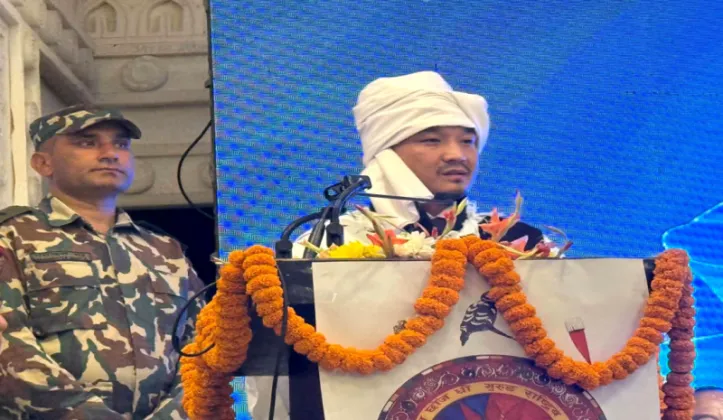
Home Minister Sudhan Gurung on Saturday said that leaders must work responsibly and remain accountable to the people at all times, stressing that no leader stands above the public. He made the remarks while addressing the 15th National Council Assembly of the Tamu Hyul Chhoinj Dhi Gurung National Council, held in Itahari in Sunsari district.
The Home Minister used the platform of the community gathering to underline the relationship between those in leadership positions and ordinary citizens, stating that public trust is something that leaders must earn and protect through responsible conduct.
Accountability at the heart of leadership
Speaking at the assembly, Gurung said that leaders must act responsibly towards the people and that accountability is not optional for anyone holding public or organizational responsibility. He emphasized that no leader, regardless of position or status, stands above the people, a message that resonated with the theme of the council assembly.
The Home Minister's remarks come at a time when questions of governance and public accountability remain prominent in national discourse. By choosing a community forum to deliver the message, Gurung tied the responsibilities of national leadership to the everyday expectations of citizens, reminding those present that the legitimacy of any leader flows from the people themselves.
A gathering of the Gurung community
The occasion was the 15th National Council Assembly of the Tamu Hyul Chhoinj Dhi Gurung National Council, an organization representing the Gurung, also known as Tamu, community. The assembly was held in Itahari, an important commercial city in Sunsari district in Nepal's eastern Tarai region, and took place on Mangsir 12 of the Nepali calendar year.
Such national council assemblies typically bring together community members, elders and office bearers from across the country to review the organization's activities, discuss cultural preservation and elect or affirm leadership. The presence of the Home Minister at the event underscored the significance of the gathering for the Gurung community in the eastern region and beyond.
Leaders urged to serve, not rule
Gurung's central message was that leadership is a form of service. He said leaders must work responsibly, framing responsibility towards the people as the fundamental duty of anyone who aspires to or holds a leadership role. The statement that no leader stands above the public served as both a reminder and a warning, reflecting concerns that leaders can become detached from the people they represent.
The Home Minister's address at the Itahari assembly adds to a broader conversation in Nepal about the conduct of public representatives and the standards citizens should expect from them. His remarks, delivered before a community audience rather than a strictly political one, positioned accountability as a value that cuts across political, social and cultural life.
Significance of the Itahari event
The choice of Itahari for the 15th National Council Assembly highlights the reach of the Tamu Hyul Chhoinj Dhi Gurung National Council beyond the community's traditional hill heartlands into the eastern Tarai, where Gurung families have settled in significant numbers. Council assemblies of this kind serve as important occasions for community members in the region to gather, celebrate their identity and engage directly with national figures.
For the Home Minister, the assembly offered an opportunity to engage directly with citizens outside the formal settings of government. His message that leaders must remain answerable to the people, delivered on Mangsir 12 in Itahari, is likely to be seen as a statement of principle about the standards of public life at a moment when public expectations of leadership continue to rise.