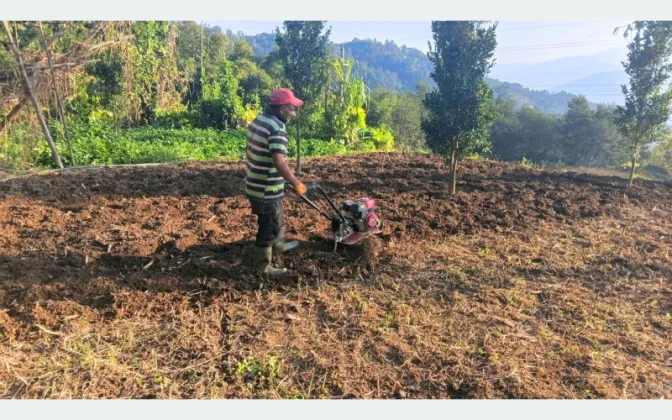
The centuries-old tradition of rearing oxen in Bhojpur district is steadily fading as farmers increasingly turn to hand tractors for ploughing their fields. Farmers who once depended entirely on a pair of oxen for cultivation are now preferring agricultural machinery, and the number of households keeping oxen has fallen noticeably compared to the past.
Machinery Replacing Traditional Farm Animals
In the villages of Bhojpur, it was once nearly universal for every farming family to keep at least one pair of oxen. The animals were essential for ploughing fields and levelling the soil before planting, making them an inseparable part of hill agriculture. Today, that picture has changed considerably, with fewer households maintaining oxen than in previous years.
The growing availability and use of hand tractors has been the main driver of this shift. Farmers find that the machines can accomplish the ploughing and levelling work that oxen once did, and many have chosen to invest in machinery rather than continue the daily labour and cost of rearing animals.
A Lifestyle Change for Farming Families
The decline in ox-rearing represents more than a change in farming technique; it marks the end of a long-standing rural tradition. Rearing oxen required families to devote time and resources year-round to feeding and caring for the animals, even outside the ploughing season. With hand tractors now doing much of that work, many farming households in the district no longer see the need to keep cattle for cultivation purposes.
The Changing Face of Hill Agriculture
Bhojpur's experience reflects a broader transformation taking place in Nepal's agricultural sector, where mechanisation is gradually replacing animal power in farming communities. While hand tractors offer farmers speed and convenience, the shift away from ox-rearing signals the fading of a practice that defined village life in the hills for generations.
As the use of agricultural machinery continues to grow in the district, the sight of oxen ploughing terraced fields is becoming increasingly rare. What was once a near-universal feature of every farming household in Bhojpur's villages is now maintained by a shrinking number of families, marking a clear turning point in the district's agricultural way of life.