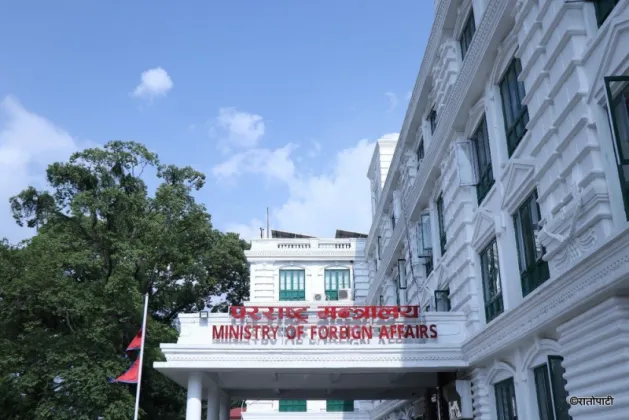
The Ministry of Foreign Affairs has begun coordinating with relevant agencies to implement the agreements, understandings and decisions reached during Prime Minister Balendra Shah's visit to India. The visit took place on Mangsir 6 and 7, during which Nepal and India reached agreement on a range of issues, most notably the adoption of a Nepal-India Joint Vision Document aimed at guiding the future of bilateral ties.
Implementation process under way
According to the ministry, the coordination effort is intended to ensure that the outcomes of the prime ministerial visit are translated into concrete action rather than remaining merely on paper. The ministry stated that the various agreements and understandings signed during the visit will now be pursued with the concerned agencies whose portfolios cover the agreed areas of cooperation.
The implementation drive follows the talks held between Prime Minister Shah and Indian Prime Minister Narendra Modi in New Delhi. During those discussions, the two sides agreed to resolve the remaining border problems between the two countries through diplomatic means, a commitment that has been formally reflected in the Joint Vision Document.
Joint Vision Document and the border issue
The ministry said the Joint Vision Document provides direction to advance Nepal-India bilateral relations in keeping with the times, and that it also addresses the long-standing border question between the two neighbours. By including the border issue in the document, the two governments have signalled a shared intent to seek a peaceful resolution of the outstanding problems.
The ministry's statement underlined that the document serves as a set of guidelines to make Nepal-India relations relevant to the present era, framing the partnership in terms of contemporary realities rather than past frameworks alone. It also affirmed that the document charts a path for seeking a solution to the Nepal-India border problem, an issue that has remained sensitive in the relationship for years.
Outcomes of the visit
Prime Minister Shah's two-day visit to India, on Mangsir 6 and 7, marked the first such high-level engagement and produced agreement on various issues between the two countries. The centrepiece of the visit was the Joint Vision Document, which the foreign ministry has now highlighted as the guiding framework for the next phase of bilateral cooperation.
With the coordination process now initiated, the focus shifts to the line ministries and relevant agencies that will be tasked with carrying forward the commitments made in New Delhi. The ministry has indicated that it will continue to work with these bodies to ensure timely and effective implementation of the decisions taken during the visit.
The emphasis on diplomatic resolution of the border issue, coupled with the forward-looking language of the Joint Vision Document, suggests that both Kathmandu and New Delhi intend to build on the momentum generated by the prime ministerial talks. The foreign ministry's follow-up coordination is the first formal step in that direction.
For more details, see the reports published by Ratopati and Nepal Lead.