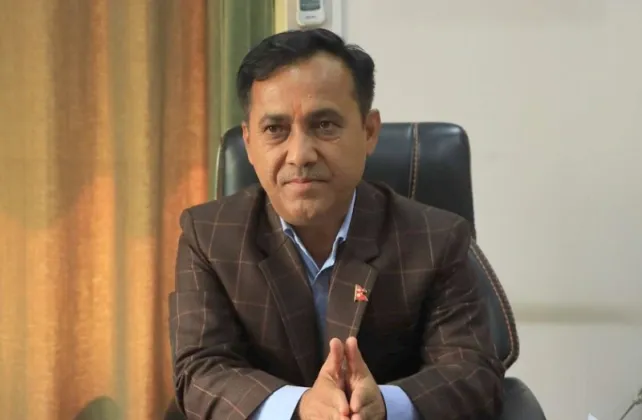
Nepali Congress Vice-President Bishwa Prakash Sharma has demanded that the Federal Parliament carry forward an impartial and transparent investigation into the questions raised in the Inam case, a matter that has stirred growing political debate in Kathmandu. Making his demand public through a Facebook post, Sharma called on the government and the Prime Minister to reveal the truth behind the issues contained in the complaint lodged at the National Human Rights Commission.
The complaint in question was filed by the wife of Inam Sapkota, and it is the contents of that complaint which Sharma says must be made public. According to Sharma, the matters raised in the complaint point to serious questions that cannot be left unanswered, and the best institutional mechanism to address them is Parliament itself, working through a fair and transparent process of investigation.
A Conspiracy, Says Sharma
In his post, Sharma went further than simply calling for an inquiry. He also posed a direct question: was Inam Sapkota put under pressure to give a statement against Nepali Congress General Secretary Gagan Thapa and others connected to the case? By raising this question publicly, Sharma framed the episode not as an isolated incident but as part of a wider pattern that deserves scrutiny.
Warning of what he described as a dangerous environment, Sharma suggested that the situation amounted to a 'give a statement and be freed, otherwise be framed' scenario. In other words, he alleged that individuals could be induced or coerced into implicating political figures, with their freedom hanging on whether they complied. Such an arrangement, if true, would strike at the credibility of any investigation and the fairness of the judicial process, which is precisely why he insisted that the truth be established openly.
The Curtain Must Be Torn Completely
Echoing the tone of his post as reflected in its title, Sharma declared that what he called 'conspiracy letters are gradually being revealed' and argued that 'now the curtain must be completely torn.' His language indicates that he believes more revelations are likely to emerge, and that partial disclosure is not enough. For Sharma, the demand is not merely for a review of the complaint at the National Human Rights Commission, but for a full and public accounting of the entire affair.
By directing his appeal to the Prime Minister, Sharma placed the responsibility squarely with the government. He asked that the truth behind the matters mentioned in the complaint be made public, framing the issue as one of transparency rather than as a partisan dispute alone. His argument rests on the premise that if serious allegations concerning pressure on a witness or accused person are raised before a national rights body, the public has a right to know how the state responds.
Why Parliament, and What Comes Next
Sharma's choice of Parliament as the forum for the investigation is significant. A parliamentary probe carries political weight and public visibility that internal departmental reviews often lack. He appears to be arguing that the questions raised in the Inam case are of a scale and seriousness that warrant the attention of the country's highest legislative body, and that an impartial and transparent parliamentary investigation is the appropriate way to resolve them.
The National Human Rights Commission, where Inam Sapkota's wife filed her complaint, is the constitutional body charged with protecting and promoting human rights in Nepal. A complaint lodged there signals that the matter touches on alleged violations of an individual's rights, giving additional weight to Sharma's call for a thorough and independent inquiry.
The Inam case has become a talking point within the Nepali Congress as well as in wider political circles, with Sharma's comments adding his prominent voice to the debate. As Vice-President of the party, his public intervention, framed around warnings of framing and coerced statements, raises the stakes of the dispute and increases pressure on the government to respond.
At this stage, the key demands remain clear: an impartial and transparent investigation moved forward in Parliament, the truth behind the complaint filed by Inam Sapkota's wife made public, and answers to the question of whether pressure was applied to secure a statement against Gagan Thapa and others. Whether the government and the Prime Minister act on Sharma's call for a parliamentary probe will determine the next chapter of a case he insists must no longer remain behind the curtain.