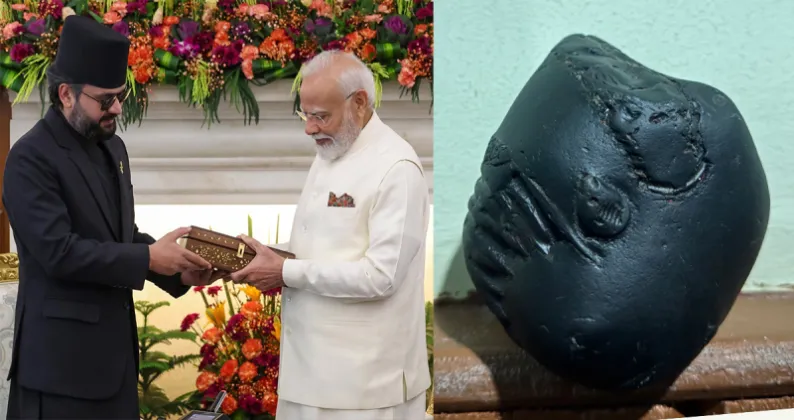
Kathmandu Metropolitan City Mayor Balen Shah has presented a Shaligram, the sacred stone revered by Hindus as a manifestation of Lord Vishnu, to Indian Prime Minister Narendra Modi. The gift, reported by Nepali media outlets, has drawn attention not only for the high-profile nature of the handover but also for the remarkable journey the stone is said to have taken: from the high-altitude landscapes of Nepal's Mustang district all the way to Hyderabad House in New Delhi, the venue where India receives visiting dignitaries.
Nepali news reports frame the presentation as both a cultural and a political gesture. The Shaligram, sourced from Mustang, carries deep religious significance in Hindu tradition, and its selection as a diplomatic gift underscores the shared cultural and religious heritage that binds Nepal and India. At the same time, the involvement of Balen Shah, a figure who has often positioned himself as an independent and nationalist voice in Kathmandu's political landscape, adds a layer of political meaning that observers have been quick to note.
From Mustang to Hyderabad House
The story that has captured public interest is the traceable journey of the stone itself. According to Nepali reports, the Shaligram originated in Mustang, the northern Nepali district famous for its ancient caves, trans-Himalayan culture and its role as a corridor linking Nepal with the Tibetan plateau. The reports trace how the sacred stone travelled from that remote Himalayan district to Hyderabad House, the stately residence and state guest house in New Delhi where ceremonial receptions and diplomatic meetings take place.
The specific details of when and how the handover occurred are not fully specified in the available reports. What is clear, however, is that the presentation took place in the context of a meeting involving Mayor Shah and Prime Minister Modi, with the Shaligram serving as the centrepiece of the encounter. The choice of venue, if indeed the exchange occurred at Hyderabad House, would lend the moment the formality of a state-level occasion rather than an informal meeting.
Why the Shaligram Matters
The Shaligram holds a distinctive place in Hindu worship. These stones, found primarily in the Kali Gandaki river system that flows southward from the Mustang region, are worshipped as non-anthropomorphic representations of Lord Vishnu. For millions of devotees in Nepal and India alike, a Shaligram is not an ordinary gift; it is an object of veneration, typically installed in home shrines and temples and treated with ceremonial respect.
Mustang's connection to the Shaligram tradition gives the gift a strong sense of place. The district sits in one of the most remote corners of Nepal, and the ammonite fossils that become Shaligram stones are washed down from its high Himalayan terrain into the riverbeds below. By choosing a Shaligram from Mustang, the gift carries with it an unmistakable Nepali identity, rooted in geography, geology and centuries of religious practice shared across the Himalayan region.
A Cultural and Political Gesture
Nepali media coverage has framed the presentation as a gesture that operates on two levels. On the cultural level, it reaffirms the civilisational ties between Nepal and India, two countries whose peoples share open borders, family links and overlapping religious traditions. A gift drawn from Nepal's sacred geography speaks to that shared heritage in a way that official documents or manufactured mementos cannot.
On the political level, the gesture is notable for who made it. Balen Shah, a rapper-turned-politician who became mayor of Kathmandu in 2022, has built a reputation as an outspoken figure, often at odds with mainstream political parties and occasionally vocal on matters of national pride. His decision to present a Shaligram to the Indian prime minister has been read by Nepali commentators as a calibrated act, one that engages India diplomatically while also spotlighting Nepal's own cultural assets.
The reports suggest that the exchange was received as a warm and symbolic moment between the two sides. The Modi government has, in recent years, cultivated ties with Nepal's political leadership across party lines and levels of government, and engagements with municipal leaders like Shah fit into that broader pattern of outreach.
Public Interest in the Stone's Journey
Beyond the politics, what has resonated with Nepali readers is the narrative of the stone's journey. The image of a Shaligram travelling from the windswept plateau of Mustang to the formal halls of Hyderabad House encapsulates, in a single object, the distance and closeness between Nepal's remotest corners and the centres of regional power.
The reports tracing the stone's path have generated discussion about the provenance of such gifts and the care taken in selecting objects that represent Nepal's heritage on the international stage. Shaligram stones, given their religious weight, are subject to particular sensitivities regarding how they are sourced, handled and transported, and media attention to this case reflects that broader public interest.
While the finer details of the handover, including its exact timing and the full agenda of the meeting in which it occurred, remain unspecified in the available reporting, the core facts are clear: a sacred stone from Nepal's Mustang district was personally presented by Kathmandu's mayor to the Indian prime minister, and the story of its passage from the Himalayas to New Delhi has struck a chord with audiences in both countries.