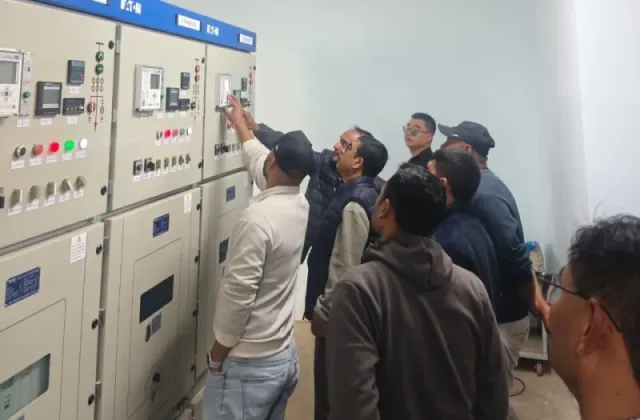
The 132/11 kV Chobhar substation, located in Kirtipur Municipality-6 on the southwestern edge of Kathmandu Valley, has formally begun operation, a move expected to make electricity supply across the valley more reliable and of higher quality. The commissioning of the substation marks a significant addition to the valley's power distribution infrastructure, which has long faced pressure from growing demand.
Two 45 MVA Transformers Installed
At the heart of the new facility are two power transformers, each with a capacity of 45 MVA. Together, they give the substation a substantial transformation capacity, allowing it to step down high-voltage electricity from the transmission network to the 11 kV level used for local distribution.
The substation is fed by the Matatirtha-Chobhar section, which was constructed under the Thankot-Chapagaun-Bhaktapur 132 kV double-circuit transmission line project. This transmission link is the key supply artery for the substation, connecting it to the wider high-voltage grid that serves the Kathmandu Valley.
Stronger Distribution for Local Areas
According to officials, the substation is expected to strengthen power distribution to local areas of the valley. With electricity delivered at a closer point of supply, consumers in and around Kirtipur and the surrounding localities stand to benefit from improved voltage levels and a more stable flow of power.
The commissioning comes as Kathmandu Valley's electricity demand continues to grow, driven by residential consumption, commercial activity and industrial use. Additional grid capacity within the valley helps reduce the load on existing substations and transmission lines, which in turn lowers the risk of overloading and supply interruptions.
Part of a Larger Transmission Project
The Chobhar substation is closely tied to the Thankot-Chapagaun-Bhaktapur 132 kV double-circuit transmission line project, one of the initiatives aimed at reinforcing the valley's electricity backbone. The double-circuit design allows power to be carried along two separate circuits on the same line structure, increasing the amount of electricity that can be delivered while adding a layer of redundancy to the network.
The Matatirtha-Chobhar section, which now feeds the newly commissioned substation, forms part of this larger transmission corridor. With the substation in operation, the infrastructure built under the project has reached a functional milestone, converting transmission capacity into tangible distribution benefits for consumers.
What Reliability Gains Mean for Consumers
For households and businesses in the valley, a more reliable and higher-quality supply translates into fewer voltage fluctuations, reduced chances of localized outages and better performance for electrical appliances and equipment. Commercial establishments, hospitals, industries and other consumers that depend on a steady power supply are among the expected beneficiaries of the improved grid capacity.
Distribution improvements of this kind are particularly significant in the Kathmandu Valley, where dense urban load centers place heavy demands on aging distribution infrastructure. Bringing a new 132/11 kV substation online at Chobhar adds a fresh injection point into the distribution network, helping balance loads across the system.
A Step Forward for the Valley's Power Network
The commissioning of the Chobhar substation represents another step in the ongoing effort to modernize and expand Nepal's electricity infrastructure as consumption rises nationwide. For the communities served from Kirtipur Municipality-6 and nearby areas, the practical impact is expected to be a steadier, higher-quality flow of electricity through the local network.
With the two 45 MVA transformers now energized and the Matatirtha-Chobhar supply line in service, the substation has formally joined the ranks of the valley's operating grid assets. Officials project that its presence will reinforce power distribution to local areas, contributing to the broader goal of a dependable electricity supply for the Kathmandu Valley.