Vijaya Dashami, the main day of the Bada Dashain festival, is being celebrated with devotion and family reunions across Nepal today, with the auspicious time for receiving tika set at 10:26 am this morning. While that hour is regarded as the most favourable moment for the ritual, devotees may receive tika, jamara and blessings from their elders at any time throughout the day, according to reports published by Global Aawaj and Pradesh Khabar.
The Auspicious Hour of 10:26 Am
According to the reports, 10:26 am today marks the most auspicious time for receiving tika on Vijaya Dashami. Families across the country traditionally arrange their Dashami gatherings around this moment, with elders ready to apply the ritual mark as relatives assemble in family homes to mark the festival's principal day.
The reports, however, make clear that the auspicious hour is a guide rather than a restriction. Tika, jamara and blessings may be received throughout the day, giving families the flexibility to complete the ritual whenever they are able to gather. This flexibility matters in a celebration that brings together relatives of different generations, schedules and places, allowing every household to observe the tradition at its own pace.
The key points highlighted in the reports are:
- 10:26 am is the most auspicious time for receiving tika today.
- Tika, jamara and blessings may be received at any time throughout the day.
- The tika and jamara are received as prasad of Nava Durga Bhawani.
- The day is being observed across Nepal as the main day of Bada Dashain.
With the auspicious moment falling late morning, households have the whole day ahead for the exchanges of tika and blessings that define Dashami, from the eldest members of a family down to the youngest.
Tika, Jamara and the Blessings of Elders
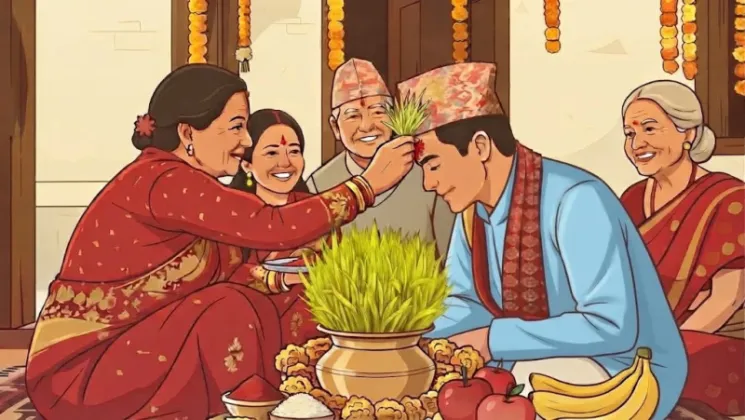
At the heart of Vijaya Dashami is the exchange between generations. Younger family members receive red tika on their foreheads and jamara from their elders, along with blessings spoken over them in turn. The reports describe these offerings as the prasad of Nava Durga Bhawani, placing the ritual at the religious core of the festival.
The blessings that accompany the tika carry the day's deepest meaning. Elders wish the younger members happiness and peace, extending their good wishes for the period ahead. For many families, this moment of receiving tika and jamara in turn, one relative after another, is the part of Dashain they hold most closely, binding the ritual to memory as much as to faith.
Together, the tika, the jamara and the blessings form the three elements that define the day: the red mark placed on the forehead, the sacred jamara received with it, and the words of goodwill offered by elders to the younger generation.
Families Reunite Across the Country
Vijaya Dashami is also a day of gathering and reunion. People across Nepal are coming together with family and relatives, filling homes where elders sit ready to bestow tika and jamara on those younger than them. The reports describe the country marking the festival's main day through precisely this act of assembly, as relatives converge on family homes to receive the prasad of Nava Durga Bhawani.
These gatherings give the day its distinctive warmth. Family members who have spent time apart come together, and the ritual of tika becomes an occasion for conversation, affection and shared celebration. With happiness and peace at the centre of the wishes exchanged, families observe Vijaya Dashami as a day of togetherness as much as a day of religious observance.
For elders, the day carries its own significance, as they take on the role of blessing the younger generation. For the young, it is a moment of receiving the prasad directly from the hands of those senior to them, a tradition that reinforces the bonds linking one generation to the next.
A Festival Day of Faith and Goodwill
The celebration of Vijaya Dashami reflects the spirit of Bada Dashain itself. As the main day of the festival, it brings together the religious act of receiving prasad of Nava Durga Bhawani and the social bonds that unite families. Reports from Nepal Lead likewise describe the day being marked across the country, underscoring the shared nature of the observance from one community to another.
As the day progresses, tika, jamara and blessings will continue to be exchanged in homes from morning onward, with the 10:26 am auspicious hour standing at the centre of the observance. Whether received at that moment or later in the day, the ritual remains the same: red tika applied by elders, jamara placed with it, and blessings wishing happiness and peace. For the families gathered across Nepal today, that shared wish is what makes Vijaya Dashami the day at the centre of Bada Dashain.